
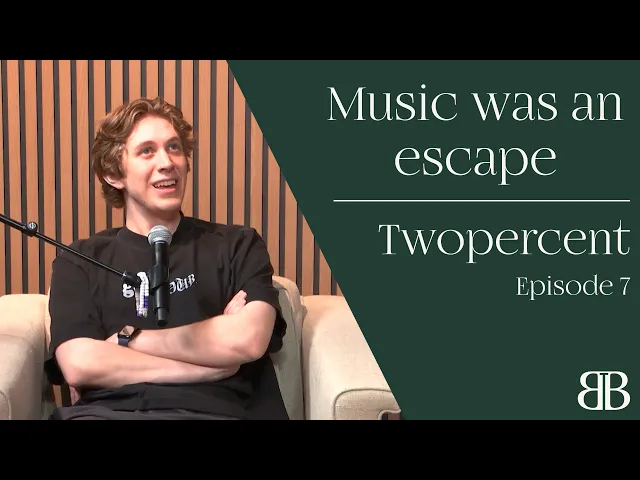
Episode details
Artist: Twopercent
Episode title: Twopercent: When Music Became the Only Path Forward
Podcast name: Beyond the Bass
Release date: 3/17/26
Genres: dubstep; dubstep; experimental bass; trap
Key topics discussed: childhood in an arts-focused family; social anxiety and early creative identity; first exposure to dubstep; dropping out of college and his mom’s cancer; music as emotional outlet and direction; mentorship and career momentum; touring, anxiety, and self-medication
Episode runtime: 1:56:21
About this episode
Elie Tentori (Twopercent) describes a life where music was always present, but not always in the same form. Early on, it came through family, festivals, instruments, and an arts-heavy education. Later, it became the one place where he could express what he was feeling more clearly than he could in the rest of life.
The center of the conversation is a stretch in early adulthood when several things hit at once: dropping out of college, his mom being diagnosed with cancer, living in his parents’ garage, and feeling directionless outside of music. He describes that period as low and disorienting, but also as the point when music stopped being just an interest and became the one path he could seriously commit to.
From there, the episode traces how that commitment began to turn into real momentum. Twopercent talks about mentors who brought him in early, the discipline of posting on socials daily, the first signs that people were responding, and the surreal jump into touring. He also stays honest about the harder parts: anxiety, people pleasing, using substances to cope, and the slower process of figuring out what kind of artist — and person — he actually wants to be.
Key moments and insights
• Music starts early through family, festivals, and a school system built around art and creativity.
• As a kid, he struggles socially and keeps returning to creative work as the place where he feels most capable.
• Cello gives him formal training, but he eventually starts to feel forced rather than alive.
• Hearing dubstep for the first time opens up a new kind of obsession that feels immediately different from everything else around him.
• College never gives him a real sense of direction, even while music keeps pulling him back in.
• His mom’s cancer diagnosis, a breakup, and dropping out of college force him to ask what path is actually his.
• Music becomes both an emotional outlet and the one thing he can control during a low period.
• Support from Hostage Situation and other producers helps turn self-belief into real momentum.
• Touring gives him the career breakthrough he wanted, but also forces him to confront anxiety, crowd expectations, and questions about authenticity.
Growing up in the arts, while feeling out of place socially
Twopercent describes a childhood in which music was woven into daily life from the beginning. His parents were both musical, his dad was always playing good music, and his mom took him to Music Together as a baby. He also grew up around festivals early. One of his earliest memories is being at a Phish festival in Vermont as a little kid, with mud everywhere and music all around.
He also grew up in Waldorf school, where art, music, and hands-on learning were built into everything. He says that environment shaped him deeply, even if he did not always appreciate it at the time. Looking back, he describes the school as a major reason creativity came naturally to him and why he developed so many unconventional interests and skills. His mom believed in that model so much, that when the family moved to Paonia, she helped start a similar school there. That background gave him a strong creative foundation long before dubstep entered the picture.
At the same time, he describes much of childhood as socially out of step. He says he had a hard time fitting in, especially around kids whose interests were more sports-based or mainstream. The place where he felt most sure of himself was not social. It was creative. He drew comics for hours, made little movies on an iPod, edited on iMovie, played cello, and kept looking for ways to express himself.
“I knew what I was good at, and that was like drawing and music stuff… I would just spend hours and hours and hours just like drawing comics or playing the cello…” (0:15:58)
That pattern matters because it returns later in the episode. Long before music became a career path, it was already the place where he felt more capable, more settled, and more himself than he did in most social situations.
When college stopped making sense, music became the only path forward
Twopercent says college was never organized around a clear goal. He went to Colorado State, first for business and marketing, then switched to communication studies, but he never felt genuine interest in what he was studying. He liked the social side of college more than the classes, and even then, he kept returning to music in his dorm instead of the work in front of him. By that point, he already knew producing reached something school never did. He could see other people finding direction through majors and classes, while he kept feeling pulled elsewhere.
That uncertainty gets much heavier when several things happen close together. He describes being in a relationship that was not good for that period of life, losing motivation for school, and then getting a call from his dad telling him his mom had cancer. He later moved back home to help, worked at Cheba Hut, and lived with his girlfriend in his parents’ garage. He calls that period “such a gnarly era” and “very low.” His mom was struggling, he felt stuck, and he did not want to go back to school, but he also did not yet know how to build a life around anything else.
“I dropped out. I have these student loans to pay back now. And I’m… living in my parents’ garage… I just need to figure something out. And the music stuff was the one thing that I was like, I could maybe do this.” (0:43:10)
He describes turning to music in that moment partly as escape, but not only as escape. It was also the first thing that felt like both an emotional outlet and a real direction. He says he was able to funnel sadness and depression into the music because by then he had enough skill to actually express something through it. That is the shift. Music stopped being just a thing he loved and became the one thing that offered both relief and momentum.
He also explains that this period taught him something about consistency. As a kid, cello never reached the same emotional places that making his own music did. But once he got deep enough into producing, he could feel music helping his mental state while also helping his life move forward. That combination made it powerful. It was not just release. It was the first thing that felt like it could alter the direction of his life.
Being taken seriously changed everything
Twopercent is very clear about the people who changed the trajectory. When he moved back to Denver and was in that low period, he started getting closer with Hostage Situation. He says they played a massive part in where he is now. They brought him into their circles, had him play a show before he was even 21, kept supporting him when his music was still rough, and eventually became the people he lived with after leaving his parents’ garage. He does not describe this as some abstract inspiration story. He describes it as real people choosing to open doors for him before he had obvious proof that he deserved it.
That support changed the way he worked. Once he was living with people who were already getting traction, he says he kept his head down and really started grinding. Around that same time, Reels were becoming central, and he made a decision that ended up shaping his career: he would post every day for a year. He says he missed only a handful of days. The growth was slow at first and often discouraging, but he kept going because he could feel small signs that the work was doing something. At the same time, he was leveling up musically through late nights in the studio, learning from people around him, and improving his sound design.
“I told myself that I would post on Instagram every day for a year… and that’s what started my career essentially.” (1:00:42)
That period is where the story becomes less about potential and more about traction. He starts seeing positive movement in SoundCloud stats, Instagram growth, and fan response. A Reel finally hits. A management group reaches out. Then a bigger company absorbs that first one, and suddenly he is getting booked on back-to-back 25-stop tours. He describes getting the call at work and realizing he was finally being offered the exact thing he had been hoping for.
The episode does not frame this as a clean arrival, though. He says he probably got ahead of himself, thought he could relax a little, spent money too freely, and later realized parts of that management situation were not really serving him the way he had hoped. But even with those complications, this stretch still marks the clearest turning point in the episode. It is the moment when hard work, mentorship, and consistency finally combine into something visible.
Touring, anxiety, and learning not to abandon himself
One of the strongest parts of the episode is how honest Twopercent is about the difference between wanting to tour and actually touring. He says those first tours were both the coolest experiences of his life and a major wake-up call. Before touring, he was deeply homebody-ish and often anxious about travel. Once the tours started, he was suddenly dealing with flights, sleepless nights, unfamiliar people, long green room hours, and the physical churn of venue to airport to hotel to venue again. He says the travel was the hardest part, especially because change is hard for him.
There was also the question of fit. On the first tour, he felt like the lineup was not a natural match for his sound. The headliner and support were playing extremely high-energy, mosh-heavy sets, while he was in more of an experimental and melodic lane. He describes looking out and seeing people stare him down, then going home from tour stops feeling depressed and convinced people did not like his music. He says that was not actually true, but it was how it felt in the moment. To deal with that stress, he says he used substances and drank more than he was used to before going on stage.
“I’d get like drunk as hell before I’d go on stage… just kind of like suppressing the feeling of like I hope that people like me…” (1:15:42)
What stays with him from that stretch is not simply that touring is hard. It is that trying too hard to please a crowd made him less happy than playing what actually felt true to him. He says he changed his sets, tried to adapt, then slowly realized that if someone books Twopercent, they are booking him for what he brings. That realization seems to matter beyond DJing. It becomes part of the larger thread of the episode: he is at his best when he is not trying to become what he thinks other people want.
That same tension shows up in the way he talks about anxiety more broadly. He says it still affects him daily and often centers on social acceptance and worrying what people think about him. He describes hyperfixating on interactions, shutting down, and feeling discouraged. Recently, he has been trying to rely less on weed as a constant way of numbing that anxiety and more on things like therapy, journaling, working out, climbing, and actually sitting with hard feelings. He does not claim to have solved it. What he does say is that he feels more clear-headed, less scared, and more able to understand how his own brain works.
It is notable that the future he describes is not only about bigger music opportunities. He talks about wanting rhythm, health, physical strength, stronger habits, more intentional relationships, and more understanding of what actually makes him happy. That makes the end of the episode feel less like a victory lap and more like a person becoming more specific about the life he is trying to build.
Artist influences and creative roots
Twopercent’s creative roots start before electronic music. He grew up around Phish festivals, Grateful Dead energy, and parents who made music feel like part of family life. He also started cello at age four after seeing an older girl play and becoming fascinated by the sound she could make with her fingers. That early formal training stayed with him, even after cello later began to feel forced.
When dubstep enters, he describes it as a real break from what he knew before. He remembers hearing “Woo Boost” by Rusko in a friend’s sister’s car and immediately feeling like it was the coolest thing he had ever heard. He also points to a Dr. P and Flux Pavillion’s remix of “Louder,” and Skrillex’s Scary Monsters and Nice Sprites and Bangarang EP as early anchors in that obsession. Later in life, he names Flume as a model for the kind of career he respects: someone who built a long run of strong music and eventually earned the freedom to make whatever he wants.
Closing reflection
What makes this episode land is that Twopercent does not describe music as a clean dream he chased from the beginning with total confidence. He describes it more honestly than that. Music was always there, but it took a period of real instability — dropping out, his mom’s cancer, a breakup, living in his parents’ garage, feeling lost — for him to realize it was the one thing he could not stop returning to. The story is not just about passion. It is about finally seeing which part of his life still held when everything else felt unstable.
That is why the episode feels broader than one artist’s path. A lot of people know what it feels like to keep circling the same thing without fully trusting it, then hit a point where avoidance stops working. Twopercent’s story matters because it shows that clarity does not always arrive through confidence. Sometimes it arrives when the alternatives stop making sense. What keeps pulling at you may be worth listening to more carefully.
Date
Mar 17, 2026