
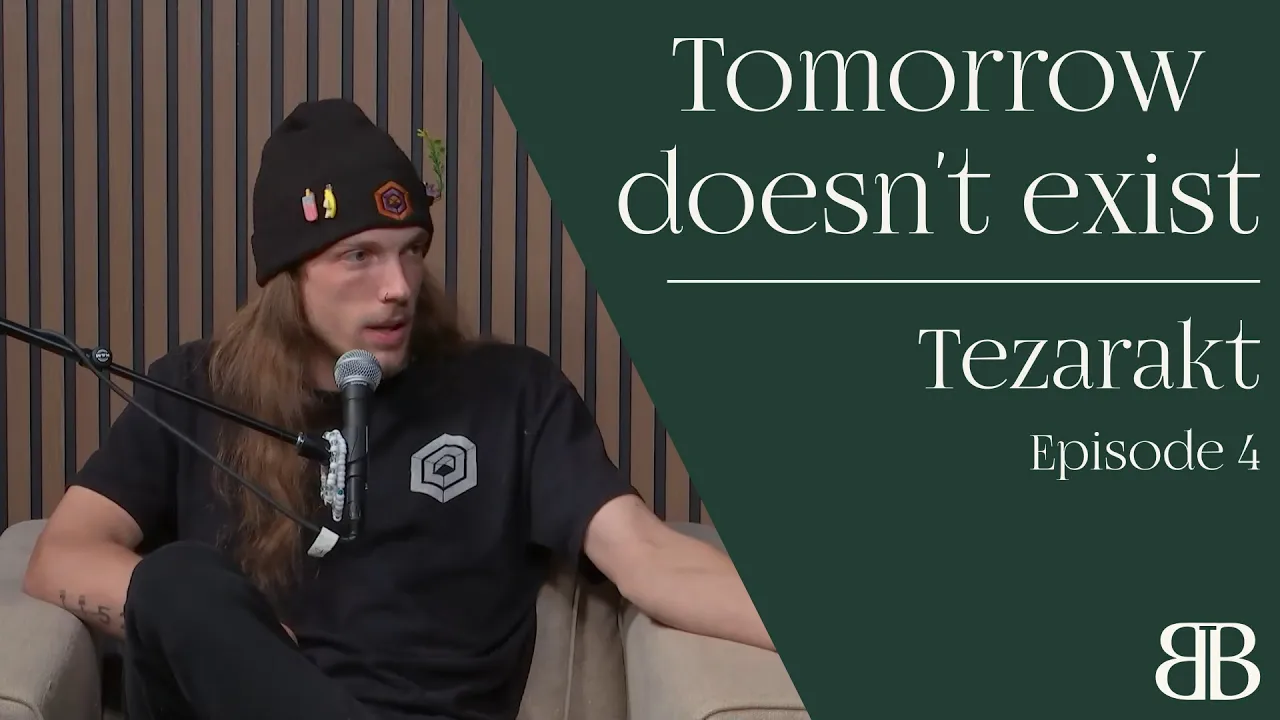
Episode details
Artist: Tezarakt
Episode title: Tezarakt: Forgiveness and the Philosophy of Now
Podcast name: Beyond The Bass
Release date: 1/23/26
Genres: EDM, dubstep, melodic dubstep, drum and bass
Key topics discussed: presence as a life philosophy; creative discipline; a pivotal Subtronics set; learning Ableton; forgiveness and healing (plant medicine/meditation); life’s peaks and valleys
Episode runtime: 1:53:47
About this episode
Jaidyn Wiese (Tezarakt) frames his life through one central idea: what’s real is what’s happening right now. In this conversation, “the philosophy of now” isn’t presented as a feel-good mantra. It’s a way he stays oriented—especially when the past pulls at him or the future starts demanding certainty.
The episode moves between music and memory: how he found dubstep, what re-ignited his obsession, and how his relationship with his father shaped the way he thinks about trust, resilience, and letting go. Underneath every topic is the same question: how do you stay present without denying what happened?
Key moments and insights
• Tezarakt explains why “tomorrow” and “yesterday” don’t feel real to him, and how that belief changes what he chooses to stress.
• He describes a disciplined stretch where he’d leave work and go straight into Ableton—measuring his days by whether he invested in his own dream.
• He traces his early attachment to dubstep through specific eras and names, then how his taste expanded and circled back later.
• A Subtronics set becomes a clear pivot point—less a show he enjoyed, more an internal switch that flipped.
• He breaks down what unpredictability does to him as a listener, and why certain moments in a set feel like “chemistry” more than sound.
• He shares how his father stopped picking him up, and how that absence reshaped his sense of stability as a kid.
• He describes using plant medicine and long conversations with friends to process his past and arrive at forgiveness.
• He names “life is a wave” as a guiding model: peaks and valleys are expected, and presence is how he rides both.
The present moment as a disciplined choice
Tezarakt speaks about presence the way someone speaks about a practice—not a mood. He doesn’t romanticize it. For him, it’s a decision to stop borrowing stress from a future that isn’t guaranteed, or donating energy to a past that can’t be revised.
That approach shows up in how he thinks about effort. If he can give eight hours a day to someone else’s dream, he believes he owes himself real time and seriousness, too. The “now” becomes both the place he works from and the place he returns to when his mind tries to run ahead.
“My big philosophy is don’t worry about tomorrow, don’t worry about yesterday because they literally don’t exist… you might not make it to tomorrow. So why get worked up about it and ruin today?” (1:46:35)
When a parent disappears, and what it takes to release it
A heavier stretch of the conversation comes when Tezarakt describes his relationship with his father collapsing in stages. He explains that after his parents divorced, he and his sister would still see their dad regularly—until the situation changed, and the visits started falling apart.
He describes being picked up, dropped off early with a made-up excuse, and then—eventually—his dad simply stopped coming. He doesn’t linger in outrage. What stands out is how clearly he names the logic a kid is forced to live with: the story changes, the pattern repeats, and you’re left to make sense of it without the information adults have.
“He would pick me up… drop me off and be like, ‘Tell your mom that I had to go pick up… whoever from the airport’… and then… he just stopped coming.” (0:23:12)
Forgiveness without pretending it didn’t matter
Tezarakt says he’s forgiven his dad, but he doesn’t frame forgiveness as a neat resolution. He’s direct that there still isn’t much of a relationship. The shift is internal: he’s no longer living inside that story every day.
He ties that change to plant medicine and, just as importantly, to processing out loud with close friends—talking until certain conclusions become real enough to live from. Forgiveness, in his telling, isn’t about excusing the past; it’s about no longer letting it control his present.
“I’ve forgiven him… I’ve used [plant medicine] to have some… in-depth conversations with my friends… and come to a lot of conclusions… I’ve definitely forgiven him… but there’s not really a relationship there.” (0:23:47)
“Life is a wave”: learning to ride the full range
Tezarakt offers a simple model that keeps him from over-identifying with any single day: life moves in waves. Some days are low. Some days are high. The mistake, in his view, is trying to lock yourself into one end of the spectrum and treating the other as a problem to eliminate.
Instead, he treats the valleys as part of the deal—something to move through without turning it into a personal indictment. Presence becomes the stabilizer: not the removal of difficulty, but a way of staying with what’s real while it’s happening.
“We’re on a constant wave… some days you’re going to be down here… and some days you’re going to be back up here… it’s about being present… you have to have the bad days if you want to enjoy the good days.” (0:32:09)
A set that rewired his relationship with music
A major pivot in the episode is Tezarakt describing the Subtronics set that turned dubstep from something he enjoyed into something he felt compelled to understand. He frames it less as vague inspiration and more as a specific kind of fascination—like he could sense there was structure underneath the chaos, and he couldn’t let it go until he learned how it worked. That curiosity becomes the bridge into production: not “I should make music,” but “I need to figure out what I’m hearing.”
He also explains what, specifically, hooks him as a listener: the unpredictability, the tension, the way a set can play with expectation and then snap into something that feels inevitable. Those moments don’t just entertain him; they trigger questions. The music becomes a puzzle with rules he can’t see yet, which is exactly why he wants to open the project file and reverse-engineer it.
That shift matters because it clarifies what drives him: not status, not a career ladder, but genuine obsession. He isn’t describing a calculated decision to start producing—he’s describing a moment where his attention got captured so fully that learning became the only satisfying next step.
“I just was blown away by everything that [Subtronics] did… I was just like, ‘This is so… crazy.’ And it would be so… cool to learn how to do this… Like how does this even work? Like what the hell is this? Cuz this has to be something deeper than just bunch of random noise and scratchy things… I need to understand and I want to understand [it].” (0:46:42)
Artist influences and creative roots
Tezarakt traces his early relationship with electronic music to formative touchstones: early Excision, early Skrillex, and the UKF dubstep era on YouTube. He also describes growing up on melodic dubstep, naming artists like Illenium and Seven Lions as part of his baseline listening during that period.
That foundation shifts decisively after seeing Subtronics live at Red Rocks. He describes the set not just as inspiring, but as the moment that pushed him from listening into producing—where his interest in dubstep turned into a need to understand how it was being made. He also mentions GRiZ (including Rainbow Brain) and LSDREAM as artists who kept that momentum alive and expanded how he listened, but Subtronics stands as the clear catalyst that set everything in motion.
Closing reflection
This episode ultimately paints Tezarakt as someone building a life around clarity: less mental time-travel, more contact with what’s in front of him. The through-line isn’t perfection or constant progress. It’s the repeated choice to return to the present, even when the past is heavy or the future feels uncertain.
Even if you haven’t lived his exact story, the core idea still lands: the only moment you can act from is the one you’re in. If you’ve been stuck replaying old pain or waiting for a future version of yourself to show up, the takeaway here is concrete—come back to now, and take the next honest step from there.
Date
Jan 23, 2026