
Episode Details
Artist: Ozztin
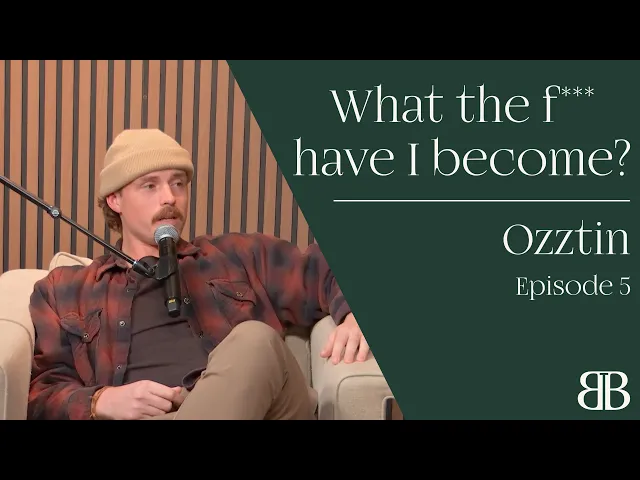
Episode title: Ozztin: Redefining Discipline, From the Marines to Music and Sobriety
Podcast name: Beyond The Bass
Release date: 2/3/26
Genres: dubstep, house, trap
Key topics discussed: leaving home and joining the Marine Corps; how discipline can become pressure; escapism and the pull of the scene; substance use (Adderall/cocaine/alcohol/weed); productivity and anxiety; the “dragon” of chasing “making it”; early festival and set moments; sobriety and learning to stay present
Episode runtime: 2:50:09
About this episode
Austin Lombard (Ozztin) describes a life shaped by two competing instincts: a real sensitivity to internal experience, and a persistent pull toward intensity. He grew up in a household where feelings were discussed openly and routinely, even when he resisted it as a kid. Later, he talks about how that early emotional structure stayed in the background as he moved into environments that rewarded toughness, control, and output.
The conversation highlights his attraction to “hardness” and why the Marines felt compelling at the time: a mix of fascination, identity, and a desire for challenge and direction. But the same story also explains why he left. He describes living inside constant monitoring and constraints while also feeling pulled toward freedom, travel, and weekends built around live music.
From there, he explains that he fell in love with the scene first, and only later felt pulled to start making music. The early allure is the vibe, the energy, and the sense of being able to step outside normal life. Over time, that becomes a craft obsession. Then the pressure to keep producing volume becomes its own engine, and he describes how Adderall and cocaine entered as a tool for productivity and stayed because they seemed to make him “better,” until the cost became impossible to deny. The later part of the episode covers what came next: the date he stopped, and the slow process of making music again sober, which he describes as far superior.
Key moments and insights
• A childhood ritual of sharing “highs and lows” teaches him how to name experience, even before he values it.
• He is drawn to the military not just for practicality, but because “hardness” and challenge feel attractive.
• While enlisted, live shows become non-negotiable, even when it means risking consequences and stretching weekends.
• He leaves the Marines because he wants freedom, travel, and the ability to experience life without constant oversight.
• His earliest attachment to EDM is the vibe and energy of the environment, not a specific subgenre.
• Electric Forest becomes a creative inflection point that reshapes what he wants to make and why.
• Pressure to produce volume turns into a productivity trap that makes drug use feel justified as long as output stays high.
• The mirror moment before a set becomes a direct confrontation with who he has become.
• Early sobriety also disrupted his creative routine, and it took time before he felt comfortable making music again.
Growing up around feelings, then choosing intensity
Ozztin describes a childhood where talking about emotions was normalized through repetition. One detail he returns to is a dinner-table practice: each person naming the high and low of their day and talking about it. He doesn’t frame it as inspirational; he frames it as real, sometimes annoying, and only later clearly beneficial.
“It’s like what’s your high of the day and what’s your low of the day and then you talk about it… Dude, I hated it when I was a kid, but as I’ve gotten older, I’m like, ‘Wow, that was really beneficial and good.’” (0:08:29)
That early comfort with emotions sits in the background as he describes being drawn to challenge and intensity later on. He wasn’t only chasing that through music—he also chased it through the environments he chose and the standards he set for himself.
Why he joined the Marines, and why he left
As a kid, he was drawn to the military —his dad took him to air shows, he watched fighter jets, and he grew up on war movies. As he got older, it also felt like a practical choice. College didn’t feel right, he didn’t like school, and the military looked like a clear path with structure, challenge, and a way to build something out of himself.
He also says directly that part of what drew him in was the hardness itself. It “seemed like hard,” “difficult,” “a challenge,” and he describes being “attracted to hardness” without needing to justify it as noble. The Marines become a place where that instinct is rewarded and amplified.
“The military came from Top Gun, bro… My dad, he took me to air shows as a kid… The air shows were big and that was like, ‘Oh, wow. The military looks pretty cool and badass.’… it just seemed like hard… I don’t know why I was like attracted to hardness.” (0:22:01)
But the same section of the episode makes clear why the structure eventually stops fitting. He describes the practical constraints: needing to request time off, being monitored, always needing to be accountable for where he is. He describes a parallel life forming on weekends—driving to shows, chasing that environment, and repeatedly taking risks with consequences just to be there. By the time he leaves, the reason is clean: he wants freedom, travel, and self-exploration, and he does not want oversight to govern his life.
“I was risking getting in trouble every weekend to just go to shows… they always need to know where you’re at… I was just like, I want to be a free bird, dude. I want to experience life… and travel without having… where they have to know where I’m at at all times. I didn’t like that.” (0:39:46)
Falling in love with the scene first, then committing to the craft
Ozztin is explicit that his earliest hook wasn’t a specific sound. It was the feeling of being in an environment where normal life shut off. He talks about being at an Excision show sober, watching the crowd, and realizing the experience was bigger than the music. When he describes his first show in this world, he remembers the lineup and specific moments, but he keeps returning to the same point: the vibe, energy and the break from everything else. For a few hours, he didn’t have to think about work, the Marines, or regular life.
He describes that first experience as different from anything he’d felt before—people were friendly, open, and the whole space felt easy to be in. When asked if he’d felt that anywhere else, he says no. The result is immediate: he starts chasing the scene itself, wanting the next rave regardless of what genre is on the flyer.
“I don’t really care about what the music is. I just want to like feel that energy again… there’s no work… there’s no Marine Corps… everybody’s just nice… that to me was like the escape.” (0:53:40)
Only after that does the craft become central. He describes a shift from being around it to wanting to build it, and he frames that as a decision to take production seriously rather than staying at the level of DJing alone. When he talks about learning, he emphasizes repetition and volume. It’s not presented as a mystical calling; it’s presented as hours after work spent watching tutorials, absorbing technique, and grinding until skill accumulates.
“As soon as I get off work… just watching insane amount of YouTube tutorials. Like I just learned… everything from YouTube.” (1:09:32)
The productivity trap, the mirror moment, and learning to create sober
The drug use in his story is not introduced as random chaos. It enters through a specific door: pressure to produce and a belief that output is the proof that he’s doing it right. He describes good things happening—his name gaining momentum—and then describes Adderall entering as a “cheat code” for making music. The key is that he’s not describing casual use. He describes it as escalating alongside pressure, and he directly connects it to productivity: more tracks, more volume, more momentum.
He also clarifies that he wasn’t prescribed Adderall. He describes trying to get medication through the VA, being given something else, and then later taking Adderall outside that system because it worked for what he wanted: production volume. Over time, the use gets more dangerous and less controlled. He describes taking multiple pills per day, describes sourcing pills from illegal websites, and admits he didn’t really know what he was taking for over a year. In parallel, he describes early touring as another accelerant—being offered free substances, the normalization of drinking and drugs, and the way access can look like a perk until it becomes a risk.
“I started taking Adderall as a cheat code to make music… I was doing Adderall because I could make a bunch of tracks. Like, I was just so productive.” (1:57:27)
This is where the productivity trap becomes explicit. He describes knowing it was damaging while still dismissing it because the short-term indicators looked good: money, output, and forward motion. In his telling, that’s what makes it hard to stop—because stopping threatens the very thing he’s using to prove he’s okay.
“I knew it was damaging… but you know why? Like in my head I was just like, well, who cares? Like I’m doing good. Like I’m making… some money… I’m making a ton of music. Like why does it matter?” (2:02:57)
The mirror moment is where that “it’s working, so it’s fine” logic stops holding up. He describes taking a huge amount of Adderall, doing cocaine, and then looking at himself in the mirror right before going on stage and not recognizing who he’d become. It’s not framed as a lesson—just a blunt moment of realizing things had gone too far.
“I did… 300 milligrams of Adderall… I got some cocaine too… and I like looked at myself in the mirror and I was just like… I didn’t know who I was… ‘what the [__] have I become?’” (2:06:55)
From there, he names a sobriety line and a date: he stopped everything on March 2nd. But the episode doesn’t treat sobriety as a single decision that fixes the rest of life. He describes a second layer that’s quieter but central to his identity: fear of opening Ableton again. He describes avoiding it for a long time, and then describes a gradual re-entry—comfort returning around month three or four. The detail is important because it reframes what recovery means in his story: not just stopping substances, but rebuilding trust that the craft still exists without the chemical pressure he used to rely on.
“It took me a long time to like open Ableton again after getting sober… I was scared of that… it took me a while to like feel comfortable again… about like month three or four.” (2:13:10)
Artist influences and creative roots
Ozztin names early live experiences as formative, and he ties them to specific lineups and genre shifts. He remembers a show sequence moving from Minnesota into Protohype into Excision, and he describes responding strongly to house songs while still not fully connecting with dubstep. (0:53:05)
He also describes a later festival moment as transformative: getting out of the military, going to Electric Forest, taking LSD, seeing Super Future as a much smaller act, and being exposed to “wook trap.” He describes that weekend as a moment where he realized he wanted to make “weird music,” and he connects it to wanting to explore lanes beyond what he’d been doing at the time. (1:34:22)
Closing reflection
This episode shows Ozztin tracing how he got stuck in a cycle: produce more, push harder, then use drugs to keep up with the pace. It started as a way to make more music, and he kept going because the results made it feel worth it. The turning point isn’t public—it’s private. He hits a moment where he can’t talk himself out of it anymore, and he realizes the “it’s working, so it’s fine” logic has stopped being true.
The broader relevance is that the productivity trap can show up in our lives too, maybe in quieter forms. This story matters because it shows how easy it is to keep justifying something when the short-term results look good—until the costs finally become impossible to ignore. The takeaway is simple: be honest about what your “output” is costing you, and make one change that helps you stay steady.
Date
Feb 3, 2026