
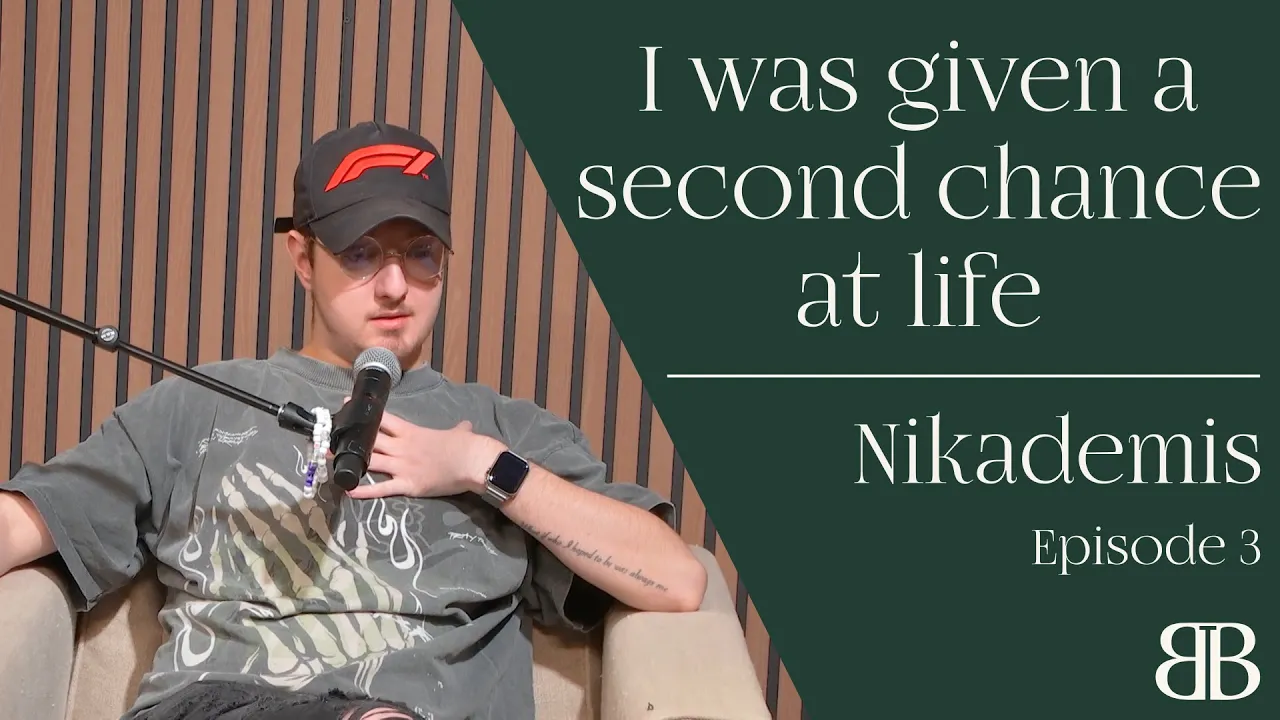
Episode details
Artist: Nikademis (Nick Liuzzi)
Episode title: Nikademis: Taming the Demons of Chronic Illness
Podcast name: Beyond the Bass
Release date: January 6, 2026
Genres: bass music, electro house, complextro, big room house, progressive house, mid-tempo, dubstep, melodic bass
Key topics discussed: ulcerative colitis, collapsed lung and recurring procedures, stress and anxiety loops, therapy, fear and self-doubt, rejection tolerance, cold outreach
Episode runtime: 2:04:30
About this episode
Nick Liuzzi (Nikademis) joins Beyond the Bass for a long-form conversation that stays focused on what his life has required internally, not what his career looks like externally. The heart of the episode is how chronic illness and major health scares can change a person’s baseline — not just physically, but mentally. He describes a vicious cycle between stress and the body, and how fear can quietly shape decisions when it goes unexamined.
Rather than treating “taming the demons” as a slogan, Nikademis frames it as a day-to-day practice. Anxiety and self-doubt don’t disappear once life stabilizes; they recur. The conversation explores what helped him build a different relationship to those patterns over time, especially therapy, and how that internal work influenced the way he moved through music, relationships, and career momentum.
He also speaks plainly about how career opportunities actually unfold: demos sitting unfinished, messages that don’t get answered, and long stretches where nothing seems to move. A lot of the depth in this episode comes from how clearly he names the mental terrain — comparison, hope, silence, doubt — and the discipline it takes to stay engaged anyway.
Key moments and insights
Nikademis describes how stress became a self-feeding loop that worsened physical symptoms.
He shares being diagnosed with ulcerative colitis in 10th grade, followed shortly by a collapsed lung.
He explains the recurring nature of the lung complications and the uncertainty that followed.
He defines “taming the demons” as working with anxiety and self-doubt instead of waiting for them to disappear.
He frames therapy as a turning point once avoidance started to carry real costs.
He describes mentorship as a stabilizing force, especially around comparison and staying focused on his own path.
A constant state of fear
Nikademis describes how chronic illness and repeated health scares created a constant sense of unease in the background of daily life. The issue wasn’t only the symptoms themselves, but the fear of recurrence — the sense that things could fall apart again without warning. Over time, that fear stopped being situational and became ambient.
“i was always stressed about my lung collapsing again all the time… and that’s what made the… bowel disease… just get worse and worse… i felt… i may not come out on the other side of this… i was given a second chance… and i’m not going to waste it.” (0:45:50)
He traces that pattern back to high school, when he was diagnosed with ulcerative colitis. What stayed with him wasn’t just the diagnosis, but the lack of closure around it — no clear cause, no definitive end point, only ongoing management and uncertainty.
“i was diagnosed with ulcerative colitis… it’s an irritable bowel disease… there’s no cure for… and there’s really no sense as to why it happens.” (0:30:51)
Throughout the episode, he keeps the focus on what this does internally. When the body becomes unpredictable, the mind often compensates by staying alert. Over time, that vigilance becomes draining, and he’s clear that it influenced how he approached risk, stability, and decision-making.
The long game of opportunity: Slander, silence, and delayed wins
Nikademis talks about a meaningful moment in his career — a collaboration with Slander — but he’s careful not to frame it as a sudden breakthrough. Instead, he describes it as a slow process shaped by patience and low expectations. At the time, he had a few demos sitting around. One stood out, but there was no assumption it would lead anywhere.
“i had made a few demos that… were just kind of sitting around… and my management… had a connection with slander’s team… ‘let’s just send over these demos’… i was like, ‘okay… sure’… did not expect anything of it.” (1:25:49)
From there, things moved — just not quickly. They responded, picked a song, and started working together. He describes debuting the track live, then waiting months before it was officially released. The delay wasn’t framed as a setback; it was simply part of how long it can take for something to fully come together.
“i had gone back to red rocks to see them again the next year… the song’s done… i think we should debut it… at decadence… we debuted the song… and it was out six months later.” (1:28:39)
He compares that experience with another one that drove the lesson home. After finishing his ‘Where I Wanna Be” remix for Big Gigantic and turning it in, communication went quiet. He assumed the opportunity had passed and stopped thinking about it — until, nearly a year later, it unexpectedly came back and moved toward release.
“i was like 10 months later pretty much… i counted it out… ‘this is not happening. this is done.’ and yeah, next thing i know…” (1:02:55)
What makes this section land is how plainly he describes the waiting. The effort happened early. The outcome arrived much later. In between, there was nothing to react to — just the choice to keep working without knowing whether anything would come of it.
Learning to stay in his own path
Late in the episode, Nikademis answers a question passed forward from BLOSSM about what he does when he feels like he isn’t doing enough — especially when social media makes it look like everyone else is constantly winning. He describes the comparison spiral as something that can feel convincing because the inputs are constant, even when they’re incomplete.
He explains that one of the first things he does is bring it to someone close to him and get perspective, instead of trying to “think his way out of it” alone. He also names the structural problem: what gets shown is mostly the highlight reel, which can distort how progress actually looks day to day.
“You're not showing the guys that like aren't getting as many views of course… you're… just showing people crushing it and then you feel like oh I'm I'm not crushing it like they are, you know?” (2:01:15)
A simple reframe helped him: other people’s momentum doesn’t invalidate his. He shares advice he got from Derek from Slander that brought him back to reality when comparison starts to take over.
“...that's their path. Good for them and you have your path and that'll be yours and that's fine.” (2:01:53)
He also mentions stepping away from social media when it’s getting loud, taking a breath, and resetting — not as a productivity hack, but as a way to stop feeding the same loop.
Artist influences and creative roots
Nikademis points to electro house and progressive house as early foundations, along with the complextro lane he gravitated toward as his taste sharpened. He describes being drawn to darker, more distorted textures, and he specifically references Wolfgang Gartner as a sound reference for that grungier, aggressive edge.
He also describes discovering “Hex” by Rezz and 1788-L through Proximity as a moment where that darker sound clicked in a new context, and he references Illenium and Justice as part of the broader musical world he was paying attention to while honing his own direction.
Closing reflection
This episode ultimately presents Nikademis as someone learning how to live alongside fear without letting it dictate his life. Chronic illness and recurring health uncertainty forced that reckoning early, but the deeper arc is internal: recognizing the stress loop, seeking support through therapy, and treating “taming the demons” as an ongoing, practical commitment rather than a temporary mindset.
For listeners, the relevance extends beyond chronic illness or music. Many people carry a similar pattern — anxiety that narrows options, self-doubt that delays action, or the tendency to interpret silence as a verdict. The grounded takeaway here is simple: fear and delay are not reliable indicators of direction. Progress often looks like continuing forward without reassurance, and letting time reveal what effort alone can’t.
Date
Jan 6, 2026