
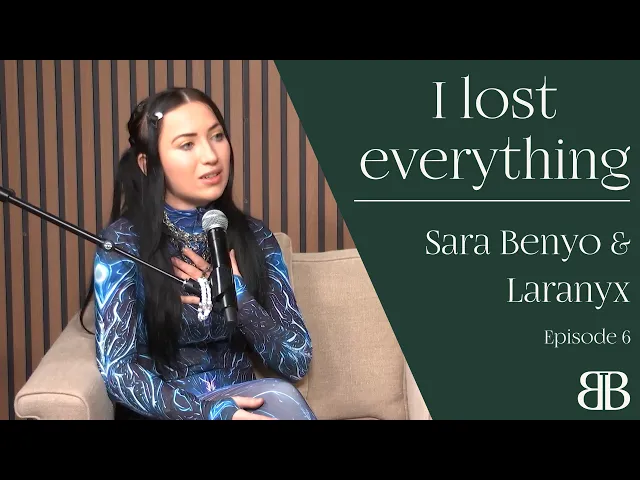
Episode details
Artist: Laranyx
Episode title: Laranyx/Sara Benyo: Shedding An Identity That Wasn’t Hers
Podcast name: Beyond the Bass
Release date: 2/17/26
Genres: EDM; dance music; dubstep; techno; indie; hip-hop; pop; post-hardcore
Key topics discussed: early bullying and anxiety; criticism at home vs support from father and grandparents; music as refuge; belonging and spirituality; dance music as “church”; being boxed in as a vocalist; self-limiting beliefs in production; finding advocates; people-pleasing and discernment; suicidal ideation; identity rebirth into Laranyx
Episode runtime: 1:53:15
About this episode
Sara Benyo (Laranyx) describes a life where music was never a side interest. It was the throughline, the place she felt most like herself, and the thing she returned to when everything else felt unstable.
In this conversation, she walks through the deeper story behind the project: early rejection, a long relationship with anxiety, and the slow work of learning to trust her own voice again.
The center of the episode is an identity shift. Laranyx traces how “Sara” became loaded over time, how being seen started to feel unsafe, and how a brutal stretch of events in 2025 pushed her into a point of no return. Not a clean reset, but a moment where she stopped negotiating with other people’s opinions and started building from her own inner knowing.
Key moments and insights
• Music showed up early as play, curiosity, and flow, long before it became a career goal.
• Anxiety didn’t start as an abstract feeling. She connects it to early rejection and repeated experiences of being singled out.
• Bullying wasn’t only peer-to-peer. She also describes teachers singling her out, and later being bullied mainly by teachers.
• Moving towns changed her environment enough to start healing the “something is wrong with me” story.
• Church youth group became less about doctrine and more about finally finding creative peers and belonging.
• Dance music later felt like another version of that belonging: unconditional acceptance and a sense of connection.
• She describes being treated like “just a vocalist,” while quietly producing for years and wanting to be seen as a full artist.
• Self-limiting beliefs around production weren’t only internal; she ties them to discouraging voices that made her doubt her process.
• The breaking point in 2025 wasn’t just emotional. It bled into her ability to function and into her sense of purpose as an artist.
• The Laranyx identity becomes a line in the sand: a way to stop shrinking, trust discernment, and move forward without needing approval.
When music is the first language you learn
Laranyx can’t separate childhood from music because, in her words, music was her first memory of being alive. She describes parents who were both musicians, a dad who was constantly trying to pull her toward instruments, and a childhood that centered around creating rather than perfecting classical pieces.
Even when she talks about anxiety later, she keeps circling back to the same contrast: music was the place where she felt natural, and the outside world was the place where she started monitoring herself. She remembers being shy about singing in front of others, including her dad, and not fully understanding why that fear was there. She describes it as something she had to work through for years.
“I was actually very scared to use my voice and to sing in front of people… I want to be a singer… But it was like I was so afraid to do it in front of people for the longest time.” (0:15:47)
The early detail that matters isn’t a neat timeline of milestones. It’s the pattern: creation felt like home, but being seen started to feel risky. That tension becomes a recurring theme in the episode, both personally and professionally.
Rejection in a small town, and the long imprint of being singled out
Laranyx traces the start of her anxiety to early school experiences where she felt pushed out for reasons she didn’t understand. She describes it as a steady accumulation: rejection in friend groups, social isolation, and later feeling targeted by authority figures.
When she first mentions “rejection” and “betrayal,” she quickly grounds it in a concrete memory from the beginning of elementary school. She describes sitting under the playground with her friend group, then being told they didn’t want to be her friend anymore. In a rural school system with limited social options, that moment didn’t just hurt. It created a lasting imprint of isolation.
“‘Hey, we have to tell you something. We don’t want to be your friend anymore.’ And you have to keep in mind like I am in a very rural town, so my school system is like incredibly small.” (0:29:39)
As she gets older, she describes the pattern expanding beyond peers. She says bullying continued across grades, and that teachers would single her out “for no reason.” Later, she describes middle school as a time where she “started getting bullied mainly by teachers,” especially as she became more visibly different in a conservative environment and started expressing herself more openly.
“It’s like in sixth grade like I had teachers just singling me out for no reason.” (0:32:38)
“I actually in middle school started getting bullied mainly by teachers.” (0:33:51)
She frames this as one of the root conditions for anxiety: not feeling safe to simply exist as herself, and learning early that standing out could come with consequences.
Belonging shows up when the environment finally changes
The story doesn’t stay stuck in childhood pain. Laranyx describes a shift that came from changing environments. As she tells it, being in a different town and a different social ecosystem made it possible to see that her identity wasn’t the problem.
She describes finding more musicians her age, and then getting involved in a church youth group because her dad pushed her toward it. What changed everything wasn’t “church” as an institution. It was the moment she started leading worship and playing with other musicians her age, and suddenly realized she wasn’t alone.
“I started playing with other musicians my age and I was like, ‘Oh my god, there’s like other kids that are my age and they’re artsy and they’re creative and they’re making music… these are my people.’” (0:38:40)
“‘There’s been nothing wrong with me this entire time. I was just in the wrong environment.’” (0:38:51)
That “these are my people” moment becomes a template she returns to later in the episode: belonging isn’t something she can force through effort or self-judgment. It’s something that emerges when she’s around people and spaces that actually fit who she is.
Dance music as “church,” and why community matters so much
When the conversation shifts toward dance music, Laranyx frames her connection to it less as a genre preference and more as an experience of unconditional acceptance. She describes dance music culture as something that holds a similar emotional function to what she found earlier: a place where people can be themselves, feel connected, and drop the sense of being judged.
“It’s like… you come to dance music and it’s like oh my god this is almost more like church than people even realize. Just the like unconditional acceptance people feel…” (0:55:05)
In her telling, that acceptance isn’t a nice bonus. It’s part of why she does what she does.
Being boxed in as a vocalist, and fighting to be seen as a full artist
Laranyx frames her early career approach as a stepping-stone. She started as a vocalist and songwriter, collaborating with producers, building a fan base through features, and planning to release original music later. She also makes a point that she had been producing for years in the background, even if she wasn’t being perceived that way.
Then the conflict sharpens: she describes how producers and the industry can treat vocalists differently than producers, and how being known as “the vocalist” can become a box you can’t climb out of. That isn’t just branding frustration. She ties it to self-worth and voice.
“Once you’re seen as like a vocalist… producers approach you and they’re like, we don’t want you on the production. We just want you as a vocalist.” (1:10:39)
She also talks about how discouraging voices got into her head earlier on, including being told her ideas were invalid because they were “just samples,” which made her doubt her process for years. Later, working with an artist coach helped her reframe that and start trusting her own creative judgment again.
Underneath all of it is one repeated question she says kept surfacing: if she keeps growing, what is her actual sonic identity? What is the anchor that’s hers, not borrowed from the collaborators around her?
The 2025 collapse, and the moment she stopped caring about approval
The most intense section of the episode centers on 2025. Before the specifics, Laranyx establishes context: years of people-pleasing, patterns of losing herself in relationships, and feeling like her need for approval made her vulnerable to the wrong people. Then she describes the result as a cluster of betrayals that happened close together, paired with feeling lost in her career.
She names suicidal ideation directly, and she describes the specific kind of darkness that comes when music feels like your purpose, but your nervous system is too overwhelmed to function.
“It literally got me to the point of like questioning my life… should I be alive?” (1:37:04)
From there, she describes a moment of prayer that she frames as both desperate and decisive. She asks for anything blocking her purpose to be removed, and she describes what followed as a kind of scorched-earth reset—events moving so fast that clarity became unavoidable.
“I literally don’t care. Whatever is attacking me like whatever is keeping me from my highest purpose on this planet and achieving that may you please obliterate it out of my life…” (1:38:32)
“…and it was like… okay bam…” (1:38:49)
She describes the outcome as losing the energy to keep negotiating herself with other people. Not a motivational confidence boost, but a point where approval simply stopped being a workable strategy.
“You just stop caring. You’re like, I don’t care if you’re my best friend and you don’t like me anymore… what do I have to lose? Like I’ve lost everything.” (0:18:18)
In that frame, Laranyx becomes more than a name. It becomes a boundary. A refusal to keep shrinking to manage other people’s comfort.
Artist influences and creative roots
Laranyx names early pop and performance fascination (Britney Spears), then points to Lady Gaga as a major catalyst that re-ignited her commitment to music after a discouraging stretch with piano teachers. She describes seeing a video of Gaga at a piano and feeling something click: a sense of recognition and certainty that this was what she was meant to do. She also references growing up around a mix of influences through family and siblings, including Eiffel 65, Jimmy Eat World, and DMX.
She also describes exposure to electronic music over time (including listening to Skrillex), and later points to the embodied experience of festivals and crowds as part of why she chose EDM as her path. For her, the influence isn’t only sonic. It’s the emotional effect of being in a room where people feel connected and unguarded.
Closing reflection
What makes this episode land is that Laranyx doesn’t frame her story as “I got better” or “I learned to believe in myself.” She frames it as something more uncomfortable and more real: she reached the end of a strategy.
From kindergarten onward, she describes learning to read rooms, monitor herself, and try to earn safety through acceptance. First it was peers. Then it was teachers. Then it was the subtle pressure of being “the vocalist,” where being valued came with a ceiling. Over time, she describes how that external pressure turned internal: self-limiting beliefs, second-guessing, and the sense that her own creative instincts weren’t trustworthy.
The shift in 2025 isn’t just a hard year that she survived. In her telling, it’s a threshold. When she says she prayed for what was blocking her purpose to be “obliterated,” she’s describing a willingness to let the false structure fall, even if it costs her comfort, relationships, and the identity she’d been dragging around for years.
That’s why the Laranyx identity carries weight in this conversation. It’s not a branding move. It’s her way of drawing a line between two versions of herself: the version that keeps scanning for approval, and the version that chooses discernment even when it’s lonely.
The takeaway isn’t a generic “be confident.” It’s that when your life is built around other people’s approval, it eventually collapses under its own weight. The way out is choosing truth over likability, finding spaces that actually fit you, and building from that—even when no one is applauding.
Date
Feb 17, 2026