
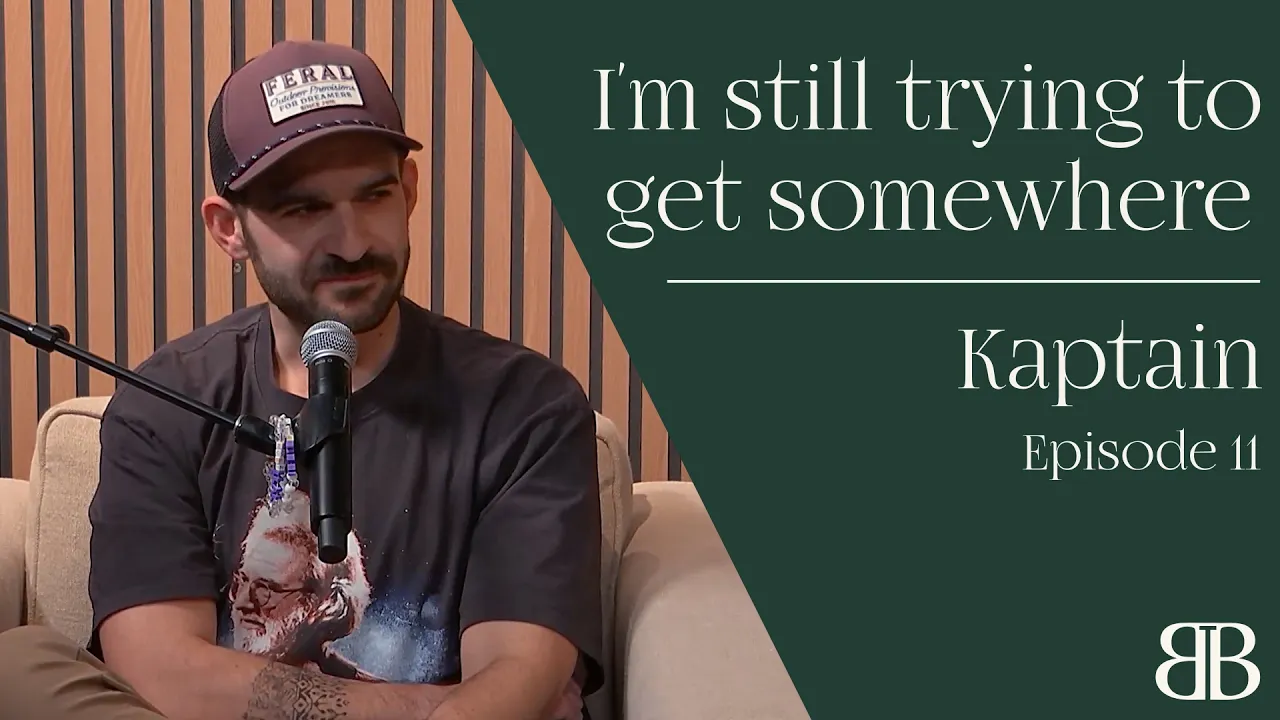
Episode details
Artist: Kaptain
Episode Title: Kaptain: Achievement, Anxiety, and Learning to Feel
Podcast Name: Beyond the Bass
Release Date: 5/12/26
Genres: Dubstep
Key Topics Discussed: achievement and self-worth; childhood pressure and anxiety; balancing music with work and family; fatherhood and identity; learning to feel
Episode Runtime: 2:05:31
About this episode
Stephen Kaplan (Kaptain) describes a life where music has remained constant through almost every major change. He grew up in New Jersey in a competitive academic environment, learned early to connect achievement with self-worth, and followed a practical path through school, engineering, and work. Music was always there, but for a long time it lived beside the more acceptable version of success he thought he was supposed to pursue.
The conversation traces how that split formed and how long it took to name it. Kaptain talks about being a high-achieving kid, absorbing pressure without fully realizing it, and using work as a way to avoid what he was feeling. He also talks about the moments when music opened something else in him: classic rock in middle school, early recording experiments, college-era EDM, festival culture, and the feeling of love and connection he found in the scene.
The later part of the episode centers on integration. Kaptain is not describing a clean story where he abandons work, becomes a full-time artist, and resolves the tension forever. He is describing something more complicated: being a producer, software engineer, husband, and new father while still trying to protect the part of himself that music keeps alive. The episode becomes less about choosing one identity over another and more about learning how to stop splitting himself into pieces.
Key moments and insights
• Growing up around academic pressure taught him to connect achievement with self-worth.
• His parents’ divorce pushed him further into work and productivity as a way to avoid difficult emotions.
• A friend introducing him to classic rock in middle school opened a more emotional and expansive relationship with music.
• Early recording experiments helped him discover the role of producer before he had a clear language for it.
• College exposed him to EDM and rave culture, giving him a sense of community and unconditional connection he had not felt before.
• After college, he chose the certainty of an engineering job while keeping music alive on the side.
• Moving to Denver helped him feel more rooted in the scene and more legitimate as an artist.
• Losing management support forced him to become more self-reliant and rebuild parts of the project on his own.
• Becoming a father brought uncertainty about music, but also helped him return to the studio with more appreciation and creative energy.
Achievement, anxiety, and the search for certainty
Kaptain describes himself as a smart, engaged kid who was comfortable around adults and authority figures. School came with clear signals: good grades, hard classes, rankings, test scores, college applications. He does not describe his parents as harsh or demanding, but he does describe growing up in an environment where achievement carried weight. His older sister was high-achieving, his town was academically competitive, and the path toward college and career felt obvious.
At the time, he did not experience that pressure as pressure. It felt like the thing he was doing because he was capable of doing it. He took hard classes, joined clubs, filled his time, and stayed on the track that seemed to promise stability. The emotional cost was harder to see while he was inside it.
That became clearer when his parents divorced when he was 15. One of his first thoughts was not only about the emotional impact, but whether everything would fall apart and whether his grades would suffer. Instead of letting the feelings come forward, he leaned further into school, productivity, and accomplishment.
“I had developed a sense of self-worth that was based on my achievement. And so if I could achieve, then I was worth something. If I didn’t achieve, I’m not worth something.” (0:14:40)
Even now, he says that pattern has not disappeared. He understands it better, but he still notices himself tweaking projects, adding side projects, and chasing some undefined next point. The difference is that he can see it now. What used to feel like ambition alone now also reads as a strategy for safety.
When music opened something beyond achievement
Music was part of Kaptain’s life early, but at first it came through a structured route. He started classical piano lessons around age six, then viola, drums, singing, and school ensembles. A family piano helped start that path, even though his parents were not musicians themselves. He is grateful for that foundation, but he also describes it as more procedural: scales, lessons, technique, and formal training.
The relationship changed in middle school when a friend named Rico introduced him to classic rock. Rico handed him a burned Led Zeppelin CD, and Kaptain remembers putting it into the stereo in his room and hearing “Communication Breakdown.” That moment opened music in a different direction. It was not only something to study or practice. It was something that could move his consciousness into a place he did not yet know how to describe.
“I honestly feel like I could almost boil it down to… popping that CD into the stereo.” (0:30:16)
From there, classic rock led into a broader musical awakening: Led Zeppelin, Jimi Hendrix, The Doors, Pink Floyd, and eventually the act of recording itself. Around the same time, Rico encouraged him to make music together. They ran a long cable from the computer room to the basement drum set and started recording. Later, Kaptain began making songs in GarageBand with creative friends who were willing to be strange, funny, and loose.
Those early recordings were not polished, but they gave him a role. He became the person who knew how to record, make beats, arrange pieces, and turn an idea into something listenable. By his teenage years, music was already taking up real space in his life, even if he still did not see it as the main path.
EDM, community, and wanting to be part of it for real
Electronic music entered first through artists like deadmau5, Daft Punk, and Justice in high school. By college, the timing was different. He moved from New Jersey to California in 2010, and the broader EDM explosion was happening around him. Skrillex, Avicii, Swedish House Mafia, Flux Pavilion, Dr. P, Pretty Lights, Porter Robinson, and others were part of the atmosphere. He was in Berkeley, away from home, absorbing a new culture, and ready for a different version of himself.
His first rave-like experiences made the music feel bigger than sound. He went to Rusko at the Fox Theater in Oakland, saw Porter Robinson before Worlds, and went to Identity Festival at Shoreline Amphitheater. The music mattered, but so did the environment around it: people taking care of strangers, offering water, checking in, and creating a kind of warmth he had not experienced in that way before.
“I really had never been exposed to that… people just being nice to each other for the sake of it.” (0:49:24)
That community element changed his relationship to the scene. He says he does not think the music alone would have connected with him as strongly without the love and care surrounding it. The shared experience gave him a home, especially after difficult high school years that he had tried to normalize and compartmentalize.
From there, the artist path became more active. He was already DJing parties and trying to get gigs around the Bay Area, but after Identity Festival he remembers coming home and DJing songs he had heard until three in the morning. Then came early production attempts, including a run of bad songs in Ableton and a period where Moombahton became his whole identity. A Sub Focus bootleg remix took off on Hype Machine and gave him the first real feeling that the project could connect beyond his immediate circle.
“It makes it feel like something you can actually pursue and build upon. So that moment gave me a ton of confidence.” (0:59:22)
Keeping music alive beside the practical path
Even after those moments, Kaptain did not leave college and go all in on music. He studied engineering, graduated, and chose the more certain route. He says the fear of uncertainty was strong. A job, a career path, and a stable structure gave him something to hold onto, even though music felt more real.
That tension followed him into adulthood. At his first job, he remembers feeling immediately that he could not believe he had to go there every day instead of making music. Still, he kept the engineering path. He also recognizes now that this was not simply the wrong choice. It gave him a life, skills, experiences, and a way of thinking that still shape his music. He likes science, engineering, and his current work. The conflict is not that one path was fake and the other was real. It is that music continued to ask something from him that the practical path could not answer.
“Music just always felt more real.” (1:09:08)
For years, that meant building Kaptain around a full-time job. He wrote music in San Francisco, took odd opportunities, played shows wherever he could, and kept trying to find his place in a scene that sometimes felt distant from him. He tells one story about flying to Michigan to play a renegade bus stage at Electric Forest without even having an official festival ticket. It is funny, but it also shows how badly he wanted to be in the room.
The bigger shift came after he and his wife moved to Denver in 2019. He had been drawn to Colorado for the music scene, especially the world around artists like Pretty Lights, GRiZ, Big Gigantic, and Gramatik. After COVID, he describes a kind of artist renaissance: meeting people, gaining respect from peers, playing more shows, and getting support from a manager who helped him access new opportunities. For the first time, the project felt like it had a real foundation.
Losing support, becoming a dad, and finding his own version of being an artist
That momentum changed when Kaptain lost a level of outside support. He does not describe the management shift with bitterness, but he is honest that it was hard. Having someone connected to the right ecosystem can open doors. Losing that kind of support made the process feel more uncertain and forced him to return to basics: networking, booking, managing himself, and taking more direct responsibility for the project.
At first, he says he tried to pretend he was not angry or upset. Eventually, the experience taught him something practical. He had been assuming someone else was waking up every day thinking about how to grow Kaptain. Whether that was true or not, he realized he had stopped investing as much in his own network, his own outreach, and his own ability to move the project forward.
“I’m the one who cares about myself the most. And I’m the one who’s the most invested in my own success.” (1:23:09)
Fatherhood brought a different kind of uncertainty. It did not make him want to quit, but it made him question what being an artist would look like now. He could not disappear on tour for weeks. He had new responsibilities. The studio door stayed closed for the first couple months after his son was born. He wondered whether music would start to feel like a silly hobby next to fatherhood.
What he found was more surprising. After the break, he began returning to the studio in small, intentional sessions. He woke up early, made coffee, and carved out time before work. He says he came back with more appreciation, more creative energy, and less of the old pressure to force something cool out of every session. The limitation did not kill the project. In some ways, it made the time feel more alive.
Now, he describes the path as chipping away: writing songs, releasing music, making content, networking, and continuing to work at Splice, where his day job is connected closely enough to music that it feels like part of the same thread. The dream is still there. Red Rocks is still a north star. Full-time music is still in his heart. But he is also learning to define being an artist in a way that fits the life he actually has.
Learning to feel instead of solving everything
The emotional center of the episode comes near the end, when Kaptain talks about his mental health journey and the song “Learning to Feel.” He says his main goal is to find the source of love in himself. For someone who learned early to seek validation through achievement, that is not a small shift. It means learning to sit with himself without needing the next accomplishment, project, gig, release, or external signal to prove his worth.
He connects that work to therapy and to a larger change in how he handles discomfort. His instinct has often been to solve, deduce, rationalize, or think his way out of pain. That instinct works well in engineering, finances, and practical problems. It works less well when the problem is emotional. His therapist’s message was simple and difficult for him to absorb: some things are not problems to solve. They are feelings to sit with.
“This isn’t a problem for you to solve. This is just a feeling for you to sit with.” (1:05:06)
That idea threads back through the whole episode. As a kid, he pushed down the difficulty of his parents’ divorce and focused on achievement. As an adult, he has had to face the cost of not recognizing that things were hard when they were hard. When Fraxure’s question asks what he would say to his younger self, Kaptain’s answer is direct: things are not necessarily okay right now, and they do not have to be okay.
That line brings the episode into focus. Learning to feel is not about becoming more dramatic or abandoning logic. It is about telling the truth sooner. It is about noticing the discomfort before it gets buried under work, achievement, or productivity.
Artist influences and creative roots
Kaptain’s creative roots begin with formal music training, but the emotional door opened through classic rock. Rico introducing him to Led Zeppelin led him into Jimi Hendrix, The Doors, Pink Floyd, and a wider understanding of how music could alter feeling and consciousness. That early shift gave him a bridge from classical technique into music as an emotional experience.
Later, electronic music expanded that world again. In high school, deadmau5, Daft Punk, and Justice introduced him to dance music before he fully understood the surrounding culture. In college, artists like Rusko, Porter Robinson, Pretty Lights, Flux Pavilion, Dr. P, Skrillex, Swedish House Mafia, GRiZ, Big Gigantic, and Gramatik became part of the world he was entering. Moombahton also became a defining early production lane for him, with artists like Munchi shaping what he was chasing at the time. Across those phases, the throughline is not one genre. It is the feeling that music can take him somewhere regular language cannot.
Closing reflection
This episode ultimately shows Kaptain as someone learning to bring the different parts of himself into one life. The engineer, producer, husband, father, skier, fan, and artist are not separate versions of him competing for legitimacy. They are all part of the same person. The hardest part has been trusting that music still counts even when it is not the only thing, and that his value does not depend on turning every passion into proof.
That is why the story reaches beyond music. A lot of people know the feeling of chasing certainty, trying to earn worth through achievement, or treating discomfort like a problem that can be solved if they think hard enough. Kaptain’s story offers a quieter correction: some parts of life do not need to be optimized before they can be real. Sometimes the work is just making enough room to feel what is already there.
Date
May 12, 2026