
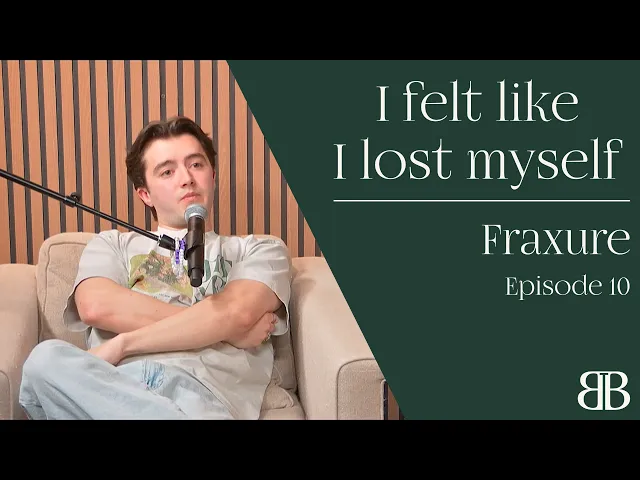
Episode details
Artist: Fraxure
Episode title: Fraxure: Chasing the Dream Without Losing Himself
Podcast name: Beyond the Bass
Release date: 4/28/26
Genres: dubstep; brostep; tearout
Key topics discussed: emotional openness in childhood; middle school and high school isolation; discovering dubstep; shifting from drawing into music; post-college job struggle and side hustles; early traction and touring; pressure to chase growth; recommitting to an album that feels true to him
Episode runtime: 2:04:44
About this episode
Peter Fithian (Fraxure) describes a path shaped by deep sensitivity and a strong instinct to throw himself fully into whatever feels meaningful. He grew up in a home where emotions were not treated as weakness, and that shaped the way he learned to move through conflict, heartbreak, and uncertainty. Later, that same intensity would show up in how he pursued art, first through drawing, then through music.
The conversation follows how that ambition survived a long stretch where the dream did not look especially glamorous. There are years of grinding in Ableton while the music still sounds bad, years of trying to turn skill into traction, and years of adjusting to the reality that passion does not immediately become a career. Fraxure talks openly about loneliness in college, the pain of watching the version of success he imagined fail to arrive on time, and the way he kept recalibrating without fully letting go.
By his own telling, 2024 was both exhilarating and destabilizing. The project was growing, shows were happening, and the career side of music was becoming real. But the pressure to make it work pushed him toward choices that felt increasingly disconnected from why he got into music in the first place. The later part of the episode follows that realization, and the decision to build something larger and more honest rather than keep chasing momentum at any cost.
Key moments and insights
• Emotional openness at home taught him to talk through difficult feelings rather than bury them.
• Dubstep first felt like a private world that was his, especially when few people around him understood why he loved it.
• He shifted from drawing to music with unusual intensity, deciding that if he was going to do it, he had to fully commit.
• College loneliness and heartbreak gave him long stretches of time alone, which became formative for his growth in Ableton.
• After graduation, the dream did not arrive on schedule, and he had to rebuild around jobs, internships, and side hustles.
• Early traction taught him that one exciting moment did not erase the need for patience and long-term work.
• Pressure from management and from himself started pulling him toward a more strategic version of the project that no longer felt fully true.
• Leaving that pressure behind and starting the album became a turning point back toward meaning, risk, and self-trust.
An emotional kid who learned to talk about it
Fraxure says he has always been emotional. He was a sensitive kid, especially around other people’s feelings, and he grew up in a family that gave him room for that. His mother, in particular, helped shape the way he related to his emotions, and he describes her influence on who he is today as enormous.
“She really taught me to just be super unapologetically comfortable with being an emotional person.” (0:16:23)
That emotional openness started early. By middle school, he was already coming home and talking to his parents about friendship drama, heartbreak, confusion, and guilt. He describes one especially painful situation involving his best friend and that friend’s girlfriend, who became his girlfriend, which ended in betrayal, fallout, and a lot of crying. Messy as it was, those years taught him how to sit with feelings before he really knew how to explain them.
Finding dubstep, then deciding to make it
Fraxure says he found his music taste in middle school, especially once Skrillex-era dubstep started blowing up. The attachment was immediate. He describes it as something that felt like his, especially because not many people around him understood why he loved it.
“I liked that it was my own thing.” (0:35:28)
He talks about dubstep as a genre that could hold a lot at once: heaviness, emotion, energy, and escape. That was part of the draw. Some of it felt aggressive and physical, some of it felt melodic and emotional, and all of it gave him a place to go that felt separate from the rest of life.
Before music, drawing had been the main outlet. He had been serious about visual art for years, looked up to artists doing work around the scene, and had even won awards for it. By late high school, he started thinking about music the same way. If this was going to be the next thing, he wanted to commit fully. The start was rough. He says the first couple years of making music were hard, slow, and often discouraging, but he kept coming back because he wanted to be an artist badly enough to endure being bad at it for a while.
“I could see the path and I always believed that if you put in the time, you’re going to get there.” (0:45:28)
College loneliness and the years when the dream did not happen on time
College seems to have deepened both the motivation and the isolation. Fraxure talks about going through a breakup at the end of high school, getting back together briefly in early college, and then watching that relationship fade in a way that left him alone for long stretches. He describes weekends in the dorm, feeling left behind socially while the person he loved was building a new life around him. Those nights became Ableton nights.
He says directly that he spent a lot of that time grinding in the DAW, often until five in the morning, even while the music was still not where he wanted it to be. The dream was already clear in his mind. He thought that by the end of college he would be making a living from music. When that did not happen, the disappointment was real. He describes it as a crushing reality check, though not one that made him stop.
“The fire of the dream was burning out a little bit, but I was kind of readjusting the path.” (0:55:30)
That became the adjustment. Instead of expecting an immediate breakthrough, he started thinking in terms of building a life that could support the music while he kept developing. That led to internships, design work, software-related jobs, sample packs, and eventually a move to Denver while still trying to make adult life work.
Traction, setbacks, and learning patience
The first real signs of traction came while the rest of life was still unstable. Fraxure talks about collaborations, remix opportunities, and getting a song onto a Disciple compilation as one of the biggest moments he had experienced up to that point. For a while, it felt like he had made it. Then reality settled back in. One exciting release did not suddenly turn into a full career.
He describes that period as a mix of motivation and frustration. When the results were not coming fast enough, his default interpretation was simple: if it was not happening yet, he needed to get better. That mindset helped push his production forward, even if it could also be brutal on him mentally.
“If I’m not getting the results that I’m wanting, it’s just because the production or the music isn’t there, isn’t good enough.” (1:09:37)
The years after college carried that same tension. He was trying to land design jobs, working internships, making sample packs, living with uncertainty, and still treating music as the long game. The dream had not gone away. It had just become slower and less romantic than he once imagined.
The year everything moved, then started pulling him off course
By 2024, things finally started moving. Fraxure was working a sales job in trucking logistics, making sample packs on the side, posting heavily, releasing the Headsplitter EP one song at a time, and starting to get real traction in Denver. Shows were coming in, management was involved, and the possibility of doing music full-time no longer looked abstract.
That was also when the pressure hit hardest. He says it was coming from multiple places at once: from management, from his own financial stress, and from the sense that he had to make the opportunity count right away. Instead of helping, that pressure started changing his relationship to the project. He found himself leaning toward styles he thought would land better rather than the music he was most drawn to making.
“It started to feel like music was no longer fun and everything was about numbers, business, or content.” (1:25:58)
He says that shift made the project feel less like a passion and more like a strategy. By the beginning of 2025, the excitement of the previous year had started giving way to something rockier. The growth was real, but so was the disconnect.
Leaving pressure behind and making something that feels true
The turning point came when he left that management situation and stepped back. Once he did, the questions became simpler: why did he get into music in the first place, and what had he always cared about most within it? His answer was not growth strategy or optics. It was sound design, production, meaning, and the possibility of making something he would actually be proud to leave behind.
That is where the album began. He talks about wanting to make a project that says something about what it means to be human while also pushing his sound design forward in a way that still feels danceable and alive.
“I’m going to take a real shot at actually doing something that is insanely meaningful to me.” (1:28:08)
He ties that decision to a day he still thinks about often: crying in his girlfriend’s arms while feeling grief and inspiration at the same time. He says he felt sad that he had lost himself, but also overwhelmed by purpose. That day became the emotional reference point he keeps returning to while making the album.
“I was sad that I kind of felt like I lost myself, but I was also so overwhelmed with inspiration and purpose.” (1:31:28)
Artist influences and creative roots
Fraxure’s roots start with dubstep as a listener rather than music as a formal discipline. He says he has no traditional musical background and did not grow up playing an instrument. Instead, his path begins through artists like Skrillex, Doctor P, Barely Alive, Virtual Riot, and Getter, whose music and surrounding culture made the genre feel both emotionally rich and creatively exciting.
Getter stands out in particular, not only because of the music, but because of the personality around it. Fraxure talks about watching the vlogs, seeing the humor and looseness in that world, and feeling like he had something in common with those people. Before music, visual art carried a lot of that same weight. He spent years focused on drawing, looked up to artists like Rob Is Real, and later seems to have brought that same visual intensity into the way he thinks about sound and identity in music.
Closing reflection
This episode shows someone trying to build a life around art without flattening himself in the process. Fraxure is ambitious, but not in a clean, one-dimensional way. He wants the project to grow, wants the music to resonate, and wants the career to work. But he keeps returning to a quieter standard too: whether the work still feels like him. That tension runs through the whole conversation.
That is what makes the story land beyond music. A lot of people know what it is like to spend years chasing something, finally get close, and then realize that success can distort the original reason you started. Fraxure does not present that realization as failure. He treats it as a correction. The takeaway is simple: if the path starts pulling you away from the part that made it meaningful, it may be time to rebuild from what still feels true.
Date
Apr 28, 2026