
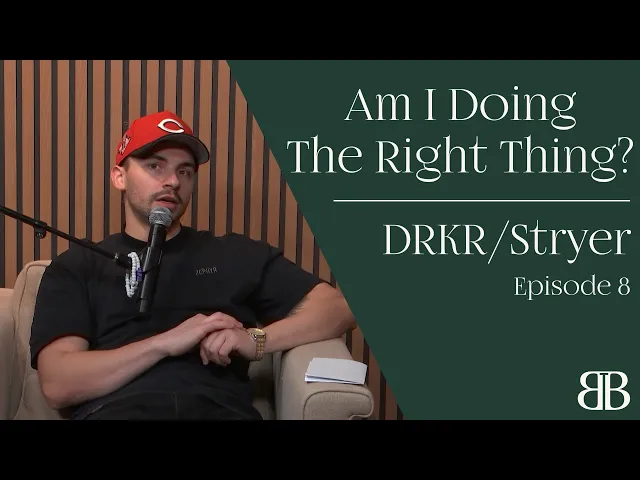
Episode details
Artist: DRKR (fromerly Stryer) (Michael Stryer)
Episode title: DRKR/Stryer: Leaving Success Behind to Start Over
Podcast name: Beyond the Bass
Release date: 3/31/26
Genres: dubstep; melodic bass; house
Key topics discussed: childhood shaped by sports and independence; comparison and pressure; discovering EDM and learning production in Denver; the rise of Stryer; losing joy in a successful project; starting over as DRKR; identity, vision, and self-trust
Episode runtime: 2:10:51
About this episode
Michael Stryer (DRKR) tells a story shaped by pressure, ambition, and a constant drive to improve. Long before music became central, that drive showed up in sports, school, side hustles, and the way he learned to measure progress. He describes himself as someone who has always had unusually big goals, along with a strong instinct to work toward them as hard as possible.
The conversation follows how that same mindset first built the Stryer project, then eventually made it harder to stay connected to it. As Stryer, he reached many of the milestones producers chase for years: major label releases, support from established artists, headline shows, Red Rocks, and Lost Lands. But the episode is not mainly about those achievements. It is about what happened when momentum stopped matching what he actually wanted to make.
At the center of the episode is a difficult shift: realizing that the project bringing him validation no longer felt creatively aligned and choosing to start over. He describes the internal conflict of leaving something that was working, the disappointment of watching much of that audience not follow him, and the conviction it took to keep building DRKR even when the growth was slower than he expected. The result is a conversation less about a reinvention of a brand and more about what it costs to stay aligned with your own creative instincts.
Key moments and insights
• Sports gave him an early model for competition, teamwork, and working toward difficult goals.
• Growing up around wealth and comparison made money and status feel loaded from an early age.
• Getting cut from his high school baseball team twice became an early lesson in persistence rather than a reason to stop.
• Moving to Denver exposed him to a scene that made music feel like a real path instead of just an interest.
• COVID gave him uninterrupted time to develop quickly as a producer and take music seriously.
• Support from Bear Grillz opened major doors and accelerated both his music career and his understanding of the industry.
• Even at the height of Stryer’s success, comparison was still distorting his ability to feel satisfied.
• Lost Lands became the unlikely place where he realized house music was pulling him more strongly than dubstep.
• Starting DRKR meant giving up momentum, disappointing some fans, and trusting that a slower but more honest path was worth it.
Competition, comparison, and learning to live with pressure
Stryer describes childhood through sports first. Baseball in particular gave him an early sense of direction, and not in a casual way. He talks about becoming captivated after his first Oakland A’s game, then going home and immediately wanting to get better. That drive stayed with him. Even as a kid, he says his goals tended to be outsized, and he remembers major league baseball as his whole world for a long stretch.
That same mindset carried into adolescence, where two things seem to have developed at once: a habit of setting very large goals, and a habit of comparing himself to people who had more. He grew up in a comfortable home, but in a wealthier environment where classmates had newer cars, nicer things, and what looked like easier access to money. He is careful not to exaggerate that gap, but he is also clear that comparison got under his skin early and stayed there longer than he would have liked.
“Early on I would say that comparison was a huge issue for me… if you compare yourself to what these other people are doing, you’re just going to hate your life.” (0:19:57)
What gives this part of the episode weight is that it does not stay in childhood. He connects those early habits directly to the present. Pressure still drives him, and he does not describe that pressure as purely negative. In his view, it pushes him forward. At the same time, he is honest that it also makes it hard to turn anything off. Even now, he talks about struggling to rest without feeling that he should be doing more.
The baseball story sharpens that pattern. He got cut from his high school team as a freshman, then again as a sophomore, and each time responded by working harder. Looking back, he treats those years less as failure than as a training ground for how he now approaches music. The lesson was not that setbacks stop mattering. It was that setbacks do not decide the outcome unless you let them.
Finding EDM, then finding a life inside it
Music was present long before it became a calling. He grew up around piano lessons, church music, country through his mom, and singalong-heavy 70s and 80s music through his dad. But he describes those influences more as atmosphere than direction. The real turn came later, during college, when EDM stopped being just songs he liked and became a world he wanted to enter.
That shift began through friends who were already going to raves and sending him sets. At first, he was hesitant. He did not like tight spaces, and the culture felt foreign. But when he finally went to Wobbleland in San Jose, the experience changed something. What he remembers most is not even the lineup. It is the feeling of arriving in a space where people were kind, open, and there for the same reason.
“I think it was just community… everyone’s going to these shows with the common goal of having a blast, forgetting about whatever is happening in life… and just going there to rage and just to have a good time.” (0:44:25)
From there, music moved quickly from fandom into practice. He started DJing with friends, then bought his own controller, then moved to Denver and found himself alone in an apartment during winter with few distractions besides the deck in front of him. That isolation matters in the story because it gave him time to move from mixing songs to wanting to make his own. He downloaded Logic, later switched to Ableton, and became the kind of person who would spend class time reading about sidechain and EQ instead of paying attention to macroeconomics in college lectures.
He also frames Denver as a major turning point, partly because he did not realize what he was moving into. He says he had no idea he was landing in a city with a deep bass scene. Once he got there, the combination of shows, friends making music, supportive coworkers, and constant inspiration made it easier to imagine a future in it. At first the goal was simple: get good. But even that simple goal was enough to pull the rest of his life into a new alignment.
When Stryer took off, comparison did not disappear
The Stryer rise happens in the episode as a series of linked opportunities rather than one dramatic breakthrough. He starts playing local shows, then gets a strange but memorable first booking at a ramen bar, then begins building more momentum in Denver. COVID, which initially looked like a setback, gave him the time and stillness to focus almost entirely on production. He describes spending ten to twelve hours a day on music while finishing school and living off unemployment. In retrospect, he sees that stretch as one of the most important periods of development he ever had.
The real acceleration came when Bear Grillz responded to a newer batch of songs and offered more than encouragement. What followed was label support, management, introductions, collaborations, and a crash course in how the business side of electronic music actually works. Stryer talks about those years with a lot of gratitude, but also with clarity about how surreal they felt at the time. He had gone from watching these artists to traveling with them, releasing with them, and learning directly from them.
That momentum eventually led to bigger labels, more out-of-state shows, headline bookings, and what he describes as the peak of the Stryer project: Red Rocks and a sold-out Larimer Lounge headline in Denver. Red Rocks stands out most clearly. It was not only the scale of the room. It was also the fact that one of his closest friends, who had driven him to that empty ramen-bar set years earlier, was there for this one too.
“By the end of my set, there’s like a bunch of people stacked up… I’ve never played to that many people… and we get off stage and we’re just in the green room jumping around like, ‘Yo, we just played Red Rocks.’” (1:12:06)
But one of the more important details in this part of the episode is that success did not quiet comparison. Even while describing moments that clearly meant a lot to him, he admits that part of his mind was still measuring them against what other artists had. The problem was not that good things were not happening. It was that those good things did not automatically produce relief.
Leaving a successful project behind and starting again
The most compelling part of the episode is the transition away from Stryer. He describes it as losing the feeling that made music worth doing in the first place. The melodic bass and dubstep he had built his name on no longer felt alive in the studio. He could still make it, and he did keep making it for a while, but he says it began to feel more like labor than discovery.
The turning point came into focus around Lost Lands, which is ironic given what that festival represents in bass music. He had already been questioning where he was heading, but the late-night house sets in the forest made something feel obvious. He started paying attention to artists like Wax Motif, Dombresky, and Matroda, and realized the excitement he felt there was different from what he was feeling when he opened his own DAW back home.
“The hard part is when you make a Lost Lands recap post and everyone’s liking it… and then I’m like closing Instagram and going to make house music… I still made dubstep, but it felt like a job. And when I would go make… my darker sound, it felt like this is a new experience. This is fun and exciting.” (1:18:32)
What followed was struggle. He expected more of the Stryer fanbase to move with him than actually did. Some did, but many did not, and he is direct about how difficult that was. He says the assumption had been that a lot of the audience he had spent years building would naturally merge into the new project. When that did not happen, it forced him into a harder reality: DRKR was not just a continuation. It was a real restart.
He also describes the identity confusion of making both at once. Stryer had become associated with emotional tone and visual identity. Early DRKR, meanwhile, was almost the opposite: darker, sleeker, more nightlife-oriented, more house-driven, and at first more exaggerated than what it eventually became. What makes this section land is that he does not claim to have handled the transition without doubt. He says plainly that he had moments of asking whether he was doing the right thing. He just never let that question become the final answer.
“Just staying focused on my goal and my vision… if I stay true to that, eventually my people are going to come.” (1:25:12)
By the end of the conversation, DRKR feels less like a rejection of Stryer than a continuation of the same pattern under different conditions. Stryer was authentic to the time he was in: more financially stressed, more emotionally heavy, more drawn to sadder music. DRKR, as he describes it now, reflects a different life and a different kind of energy.
Artist influences and creative roots
Stryer’s early musical roots were broad before they became electronic. He grew up around piano, church music, country through artists like Tim McGraw, Kenny Chesney, and Garth Brooks, and 70s and 80s singalong music through artists like the Bee Gees, Michael Jackson, and Neil Diamond. He links those early influences to his later attraction to emotional, melodic material rather than treating them as separate from what he does now.
His path into EDM came first through artists like Calvin Harris, DJ Snake, Martin Garrix, and LMFAO, before dubstep became central. Later, the bass side of the scene took over through Wobbleland, Denver, and the years he built as Stryer. Then, much later, the house turn came into focus through late-night Lost Lands sets and trips to Miami Music Week and Ultra. He names artists like Wax Motif, Dombresky, and Matroda as part of that pull.
Closing reflection
What this episode ultimately shows is a person who did not walk away from failure. He walked away from a version of success that had stopped feeling honest. Michael Stryer had already built something real as Stryer. He had audience, validation, milestones, and momentum. The harder move was recognizing that those things were no longer enough to keep him connected to the work itself, then choosing to absorb the cost of starting again.
That is what makes the story matter beyond music. Many people know what it feels like to keep doing the version of life that others already understand, even after some deeper part of it has gone flat. The risk is not always failing publicly. Sometimes it is leaving something that still looks like it is working. The takeaway here is simple: if the work that once made you feel alive has started to feel like obligation, it may be worth paying closer attention to what still feels genuinely yours.
Date
Mar 31, 2026