
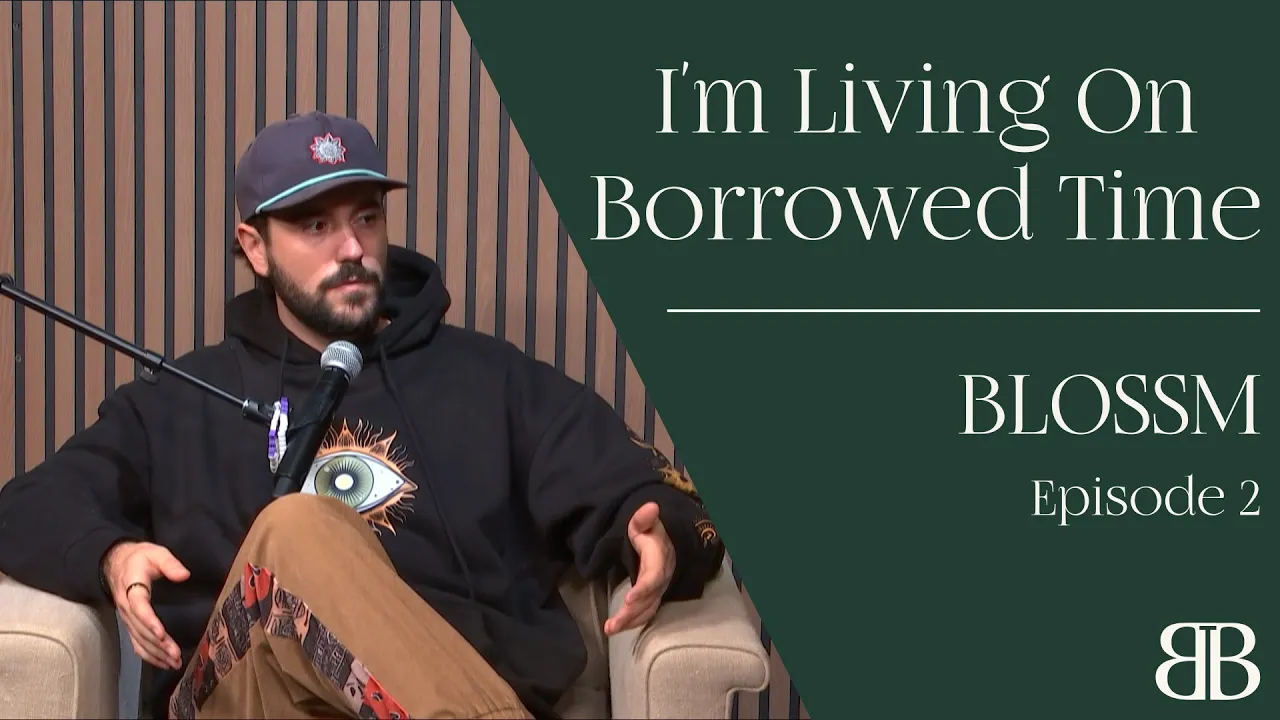
Episode details
Artist(s): BLOSSM (Tom Bluher)
Episode Title: BLOSSM: Addiction, Recovery, and a Second Chance
Podcast Name: Beyond the Bass
Release Date: December 23, 2025
Genres: Bass Music, Heavy Bass, R&B, Funk, Boom Bap
Key Topics Discussed: addiction, fentanyl, suicide ideation/attempt, sobriety/recovery, self-forgiveness, therapy, plant medicine, mindfulness/meditation, community-building
Episode Runtime: 02:36:33
About this episode
Tom Bluher (BLOSSM) joins Beyond the Bass for a long-form conversation that stays focused on lived experience rather than career highlights. The episode begins with a clear content note: the conversation includes addiction, drug use, and suicide ideation—shared with the intention that it might help someone who relates.
What stands out is how directly Bluher describes the internal logic of addiction: not as drama, but as a narrowing of options and a loss of agency. He walks through the moment his life reached a breaking point, and how recovery became less about “fixing” himself and more about choosing life one honest decision at a time.
As the conversation moves into the present, Bluher describes BLOSSM as more than a music project. It’s a framework for conscious community—using shows, sound, and mindfulness as a place for people to reconnect with themselves and each other.
Key moments & insights
Bluher describes writing a suicide note during the depths of addiction, then experiencing a brief “moment of clarity” that led him to call a friend for help.
He shares that fentanyl quickly destabilized what little “semblance of stability” remained in a short window of time.
After a hospital stay and psych hold, he describes a quiet pivot point—waking up to sunlight and snow and recognizing he couldn’t keep going the same way.
He frames music (and shows) as a sober, embodied outlet—being fully present and expressive without needing substances.
He describes a later stage of healing where self-forgiveness became real on a deeper level, tied to extensive preparation, plant medicine, and sustained sobriety.
BLOSSM becomes a deliberate identity shift: not just a new name, but a commitment to conscious community and service inside the scene.
Hitting bottom, then choosing help
Bluher describes the end-stage of addiction with almost no poetic distance—just events and decisions stacked on each other. He talks about running out of money, writing a suicide note without fully feeling “present” in his own body, and attempting suicide.
“...I literally was so deep in my addiction that in my head the two choices that I had were either die… or get sober.” (1:05:45)
What changes the trajectory isn’t motivation or inspiration. It’s a brief clearing—what he calls a “moment of clarity”—followed by a direct ask for support. He calls a friend at 4 a.m., they answer, and they physically come get him.
“...I had what us people in recovery like to call a moment of clarity… I looked at the note… ‘What the fuck am I doing?’ And I called a friend.” (1:06:14)
He then describes the aftermath—overdose, seizure, hospitalization, a suicide hold, and being left alone in a locked room for hours. The story isn’t told for shock value; it’s told with the underlying message that the turning point often comes after things feel irrecoverable.
“...they put me into a… locked room, basically a jail cell with cameras, and I sat there for 12 hours… and they just left me there.” (1:07:30)
Forgiveness with the help of therapy & plant medicine
Later in the conversation, Bluher describes a different layer of recovery: not the initial survival stage, but the internal reckoning that can linger long after sobriety begins. He talks about reaching a point where he could forgive himself—not just conceptually, but at a deeper level that felt integrated.
That breakthrough is inseparable from the role plant medicine played in his healing journey. He describes being introduced to plant medicine ceremonies through his partner (now fiancée), and frames the path into that world as gradual and structured—starting with grounded practices (like cacao ceremony + meditation) before anything more intense.
He then describes a ceremony experience where the “second round” became the turning point—leaving the circle, sitting in the grass, hands on the earth—followed by a level of forgiveness he hadn’t been able to reach through conscious effort alone.
“...I left the ceremony circle and I sat outside in the grass and I just put my hands on the ground and I entirely forgave myself...” (2:18:00)
Importantly, he’s careful not to frame this as a shortcut. He explicitly ties it to preparation: years of sobriety, therapy, and sustained effort that made him ready for that experience rather than trying to use it to bypass the work.
“...everything that happened up to that point needed to happen... I needed to go and be sober entirely from everything for 3 years and... go through therapy...” (2:20:17)
That framing matters because it positions healing as earned—built through consistency and support—rather than a single transformative event that erases the past.
BLOSSM as identity shift: from “project” to community practice
Bluher’s shift into BLOSSM starts with something grounded: family. After being signed, he realizes his original artist name would place the family last name in the public spotlight in a way his brother didn’t want. Instead of defending the branding, Bluher changes course.
From there, the name BLOSSM isn’t treated as a marketing move. He connects it to a personal symbol—sunflowers—as a recurring reminder to return to his healing path and stay oriented toward what’s true.
“...whenever I see them… I always see that as a sign… you’re in the right place… a cue… to root back into… my healing path…” (1:45:19)
When he talks about what the BLOSSM project is now, he focuses on community: conscious people using music as a tool for healing, authenticity, and service inside the scene. He describes shows as a place where he can be fully alive and expressive while sober—and wanting to find and cultivate that same energy in others.
“...I want to build a community of… conscious people… using music as a way to heal… the same way that I use music…” (1:47:30)
Creative roots
Bluher’s creative roots start in live instrumentation and groove. He describes learning bass, getting deeper into music theory, and finding his stride playing in an R&B band—covering artists like Stevie Wonder and Aretha Franklin.
“...we were playing like a lot of Stevie Wonder covers and Aretha Franklin… groovy R&B tunes…” (32:59)
He also ties his broader scene influence to living in Denver during the rise of glitch hop and electronic acts pulling heavily from funk/soul—naming Big Gigantic, Opiuo, and Pretty Lights as part of the sonic ecosystem around him.
But the pivotal ignition moment is specific: seeing GRiZ at Red Rocks as a teenager—hearing the sax, the basslines, the grooves—and realizing, viscerally, I want to do that.
“I remember… going crazy to GRiZ and I was like I want to do that… that’s what sparked it…” (34:04)
On the community and service side, he points to artists who use their platform to encourage self-care and act in service—calling out LSDREAM as a reference point for how he wants to show up, especially in sobriety.
Closing reflection
This episode doesn’t treat sobriety as a clean redemption arc. It’s presented as a sequence of hard realities, honest decisions, and ongoing practice. BLOSSM, in that sense, becomes less a “brand” and more a personal commitment: to remember what nearly happened, to keep returning to the work, and to build a corner of the scene where healing and music can exist together without pretending it’s easy.
For listeners, the relevance goes beyond addiction. This is a story about any pattern that starts as coping and ends up costing you your life—whether that’s substances, avoidance, self-hatred, perfectionism, or the quiet belief that you don’t deserve a second chance. The deeper takeaway is that change doesn’t come from “wanting it” hard enough; it comes from honesty, support, and taking the next right step even when you don’t feel ready. And if you’ve ever felt stuck in something you can’t explain to other people, this episode is a reminder: you’re not uniquely broken, and you’re not beyond repair.
If you or someone you know is struggling with suicidal thoughts, in the U.S. you can call/text 988 (Suicide & Crisis Lifeline).
Date
Dec 23, 2025