
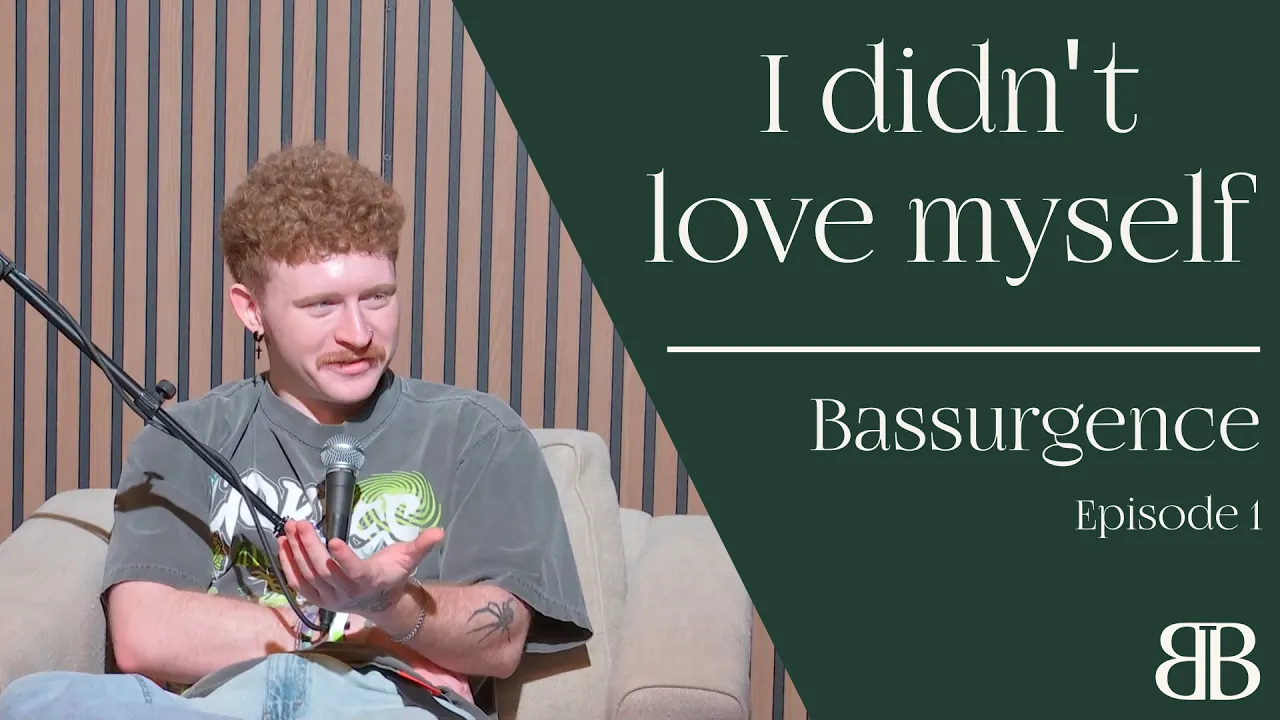
Episode details
Artist: Bassurgence (Johnny Ruffin)
Episode Title: Bassurgence: The Self-Love Breakthrough Behind His Music
Podcast Name: Beyond the Bass
Release Date: December 9, 2025
Genres: Dubstep, Reggae-DNB, Bass Music
Key Topics Discussed: The Hoffman Process, self-love, creative discipline, relationships, intention in art
Episode Runtime: 01:25:15
About this episode
Johnny Ruffin (Bassurgence) is a Colorado-based bass music producer whose work blends dubstep with reggae-influenced drum and bass. This article is based on a direct, long-form conversation recorded for the Beyond the Bass podcast.
The conversation centers on Ruffin’s early life, marked by frequent moves, family instability, and the need to adapt quickly to changing environments. Those patterns carried into adulthood through difficult relationships, burnout, and a persistent sense of self-doubt. Music existed during his early life, but often with uncertainty, rather than from a grounded place.
A major turning point came through Ruffin’s experience with the Hoffman Process, an intensive therapeutic retreat focused on identifying emotional patterns formed early in life. Ruffin describes the experience as a reset—not because it removed struggle, but because it helped him see his behaviors more clearly. That awareness changed how he related to himself, his relationships, and his creative work.
Throughout the episode, Ruffin reflects on what self-love looks like in practice rather than theory. He talks about leaving situations that drained him, learning to sit with fear instead of avoiding it, and committing to music consistently even when lacking confidence. These changes affected how he approached sound design, decision-making, and his expectations of himself.
The episode is less about music as a product and more about music as an extension of lived experience. It offers a window into how personal clarity can reshape creative output, without positioning the artist as finished or fully resolved.
Key moments & insights
Recreating a sound from Inzo’s “Overthinker” marked a shift where Ruffin stopped viewing other artists as untouchable and began seeing their skills as learnable.
His “Smokin Love” remix became a personal confidence marker, reinforcing trust in his creative instincts.
Growing up in many different homes helped Ruffin develop adaptability, which he later connected to creative and personal resilience.
Ending a high-conflict relationship just before entering the Hoffman Process created space for deeper self-reflection.
Ruffin describes using an internal, intuitive dialogue to guide decisions when external feedback feels overwhelming.
He intentionally avoids constant activity in favor of slower, more deliberate growth.
Ruffin believes meaningful art reflects lived experience and emotional effort, not just output.
He limits his engagement with social media after posting to avoid fixation on feedback and comparison.
The Hoffman Process and learning self-trust
Much of Ruffin’s personal shift traces back to his time in the Hoffman Process, a week-long retreat focused on identifying emotional habits formed early in life. Ruffin recalls writing down over a hundred recurring patterns during the process, including avoidance, people-pleasing, and a deep belief that he wasn’t enough.
"I think what it boiled down to is I didn't love myself truly. And I think the most important thing that the Hoffman process taught me was to love myself." (0:35:47)
Rather than trying to eliminate these patterns, the experience helped him notice them without immediately reacting. Ruffin describes this awareness as the beginning of self-trust—learning to pause before default behaviors took over.
He makes a clear distinction between talking about self-love and practicing it. For Ruffin, self-love showed up as actions: leaving relationships that felt misaligned, setting boundaries, and continuing to create even when fear or doubt was present. These choices slowly replaced the need for external reassurance.
That internal shift changed how he approached music. Instead of relying on chance or luck in the studio, Ruffin began working with more intention. Sound design became less about experimentation for its own sake and more about expressing a specific feeling or idea.
Choosing intention over urgency
Ruffin speaks openly about resisting pressure to always be active or visible. Rather than saying yes to everything, he focuses on pacing himself in a way that feels sustainable. This approach is rooted in self-awareness—knowing when doing more would actually be less productive.
He balances a full-time job with long nights making music, often working late into the early morning hours. Consistency, he says, matters more than motivation. Showing up repeatedly, even when the work feels imperfect, is how trust in the process is built.
In his production work, he spends long periods refining small details, aiming for sounds that feel emotionally accurate rather than impressive. The goal is not volume, but honesty.
"I think it’s just consistency. I think that’s the key to making it. I think so many people go in bursts and then they pull back and then burst and then pull back… it’s about building momentum and keeping that momentum going." (1:05:59)
Art, technology, and human experience
Ruffin is thoughtful about the role of technology and AI in music. His concern isn’t about tools themselves, but about losing the human element behind the work. He believes music carries weight because it reflects effort, frustration, learning, and time.
“I mean, the only point of art that matters is the fact that it comes from a human. It's an extension of the imagination. It's a piece of the soul.” (00:48:46)
Having spent years honing his craft, Ruffin sees each phase of struggle as part of a larger creative voice. To him, removing that process removes meaning. Art, in this sense, is less about efficiency and more about presence.
Ruffin also discusses visualization and regularly imagines himself on large stages, not as wishful thinking, but as a way to align daily choices with long-term direction. For him, imagination is a form of practice.
Artist influences & creative roots
Johnny identifies his entry into the genre as a deeply emotional experience, specifically pointing to Inzo’s track "Overthinker" as the spark that first drew him in. He describes hearing the song during a drive and being so moved by its composition that he replayed it "a million times," marking the beginning of his obsession with bass music. After recreating a complex "chord womp" from the track, he stopped viewing other artists as "gods" and he realized that the skills of his idols were not unreachable mysteries, but learnable techniques.
"It was the moment where I stopped looking at these artists as gods. I was like, 'Okay, I can do something that you can do in, you know, my own rudimentary way, but it's the concept.'" (0:20:55)
Beyond “Overthinker,” Johnny describes being influenced by the raw, high-energy sounds of artists like Gorilla T, and the deeper self work he’s done. He credits the Hoffman Process as a transformative influence on his craft. Johnny emphasizes that his sound is a reflection of his lived experience—blending the rhythmic soul of reggae with the intensity of dubstep to create something he describes simply as "honest."
Closing reflection
This episode ultimately shows Bassurgence as someone building a more honest relationship with himself in real time — not just as a producer, but as a person learning how to move through anxiety, pressure, and self-doubt with more intention. Instead of chasing a dramatic “before and after,” he points to smaller shifts that actually stick: noticing patterns, choosing self-trust over comparison, and letting internal clarity shape the way he creates and shows up.
For listeners, the relevance goes way beyond making music. Most people know some version of the same loop: trying to prove yourself, getting trapped in comparison, and living at the mercy of your own inner critic. This conversation matters because it offers a practical alternative — slow down enough to hear what’s true, then take the next right step from there. The takeaway isn’t “fix yourself.” It’s: build self-awareness until your choices start coming from you again, not from fear.
Date
Dec 9, 2025