
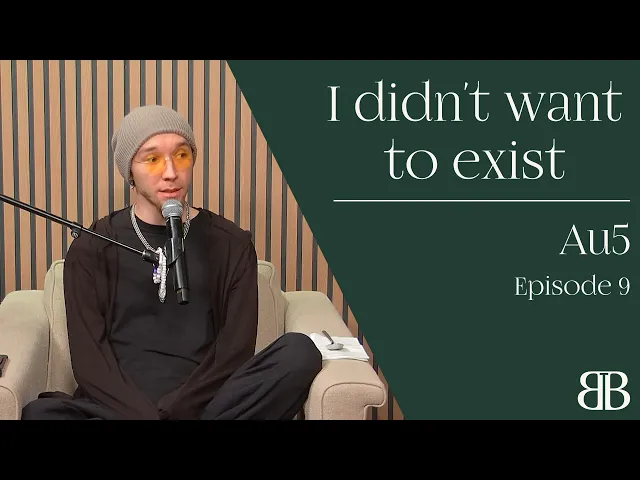
Episode details
Artist: Au5
Episode title: Au5: Pressure, Pain, and Trusting His Intuition
Podcast name: Beyond the Bass
Release date: 4/14/26
Genres: dubstep; melodic bass
Key topics discussed: childhood pressure and validation; music as escape and identity; high school isolation and depression; early artistic breakthrough; mentorship and leaving school; trusting intuition in music; burnout, grief, and creative realignment; relationships, collaboration, and emotional honesty
Episode runtime: 3:08:34
About this episode
Austin Collins (Au5) describes a life where music was present almost before language. From the start, sound was not just something he liked. It was something he experimented with, organized his inner world through, and used to feel more fully alive. But that relationship with music did not develop in a vacuum. It formed alongside early pressure to perform, a strong need to be seen as exceptional, and a deep sensitivity to other people’s approval.
The center of the conversation is not his résumé, even though the episode covers major milestones: leaving school, early support from Excision and Monstercat, mentorship from BT, years of releases, touring, and a long career in the scene. What gives the episode its shape is something more internal. Again and again, Au5 returns to the same question: how do you stay connected to what is actually true for you when pressure, pain, and expectation start pulling you away from it?
That question runs through nearly every chapter here. It is there in childhood, when praise and performance start getting linked. It is there in high school, when isolation becomes severe enough that he no longer wants to exist. It is there later, when he is told to pick a lane, when he releases music that fans reject, when a major project leaves him creatively frozen, and when touring fails to feel the way it was supposed to. By the end, the story becomes less about success in the usual sense and more about learning to trust the inner signal beneath noise, fear, and expectation.
Key moments and insights
• Early praise and reward systems teach him to link being “good” with being loved and validated.
• Music becomes both a place of curiosity and a private refuge from school pressure and emotional overwhelm.
• The transition to public high school leaves him socially stranded and deeply depressed.
• Sharing his music with classmates in senior year becomes an early turning point in feeling truly seen.
• Meeting Fractal and later BT gives him both artistic direction and permission to trust his own path.
• Leaving school is less a rebellion than a response to finally being recognized in what mattered most to him.
• The loss of his connection with Fractal becomes one of the defining grief experiences of his adult life.
• He refuses repeated pressure to simplify himself artistically, even when that costs touring opportunities and audience clarity.
• His later work and worldview grow out of the same lesson: when he abandons intuition, everything starts to break apart.
Validation, performance, and the pressure to be exceptional
Au5 describes a childhood in which music and pressure arrived together. He was given a Casio SK-1 as a toddler, started noticing pitch and pattern almost immediately, and was in piano lessons by age four after his parents noticed how naturally he was responding to music. But the emotional context around that talent matters just as much as the talent itself. He says that from a very young age, being watched and performing well became tied to identity. Eyes were on him, and the goal was not only to play well, but to be impressive.
That pressure was reinforced elsewhere. He grew up in a small Quaker private school where good behavior and correct answers were rewarded. Looking back, he connects those early systems to something much larger: the idea that doing well, presenting well, and being proficient brought validation, and that validation was how he often experienced love. He is careful here. He says his parents were loving and supportive. But he also describes feeling comparison intensely, especially when he heard other people criticized. He internalized the message that he had to avoid becoming one of the people who fell short.
“There’s this correlation between doing well… presenting well and receiving validation. And that’s how I felt love most of the time.” (0:20:04)
What follows from that is a pattern that runs through the entire episode. He becomes highly sensitive, highly self-aware, and highly avoidant. He talks about dissociation, isolation, and privacy not as personality quirks, but as protective strategies. If the environment cannot be controlled, his instinct is to disappear into himself. That early split between what he felt internally and what he believed he needed to present outwardly becomes one of the deepest tensions in the story.
Music as refuge before it became a career
Before music was public, it was private. Au5 says he would listen to songs on repeat for hours as a child, bathing in the emotional world they created. Later, when he got an early iMac and found a simple MIDI sequencing program, that inward relationship with music became active. He was not only hearing sound anymore. He was arranging it, replaying it, and using it to leave behind the parts of life that felt overwhelming. Homework, school pressure, and the constant need to be a good student all pushed him toward the computer, where making songs felt more absorbing and more alive than anything else he was supposed to be doing.
That is one of the clearest parts of the episode: music first became an escape before it became a profession. He says directly that making music trained him to dissociate from pressure, which later became complicated once music itself turned into work. But at the beginning, the relationship was simple. The best part of it was the freedom to hear something in his head and bring it into the world. He describes that process almost as a bodily need: if something did not yet exist and he could imagine it, he wanted to make it real.
The same pattern appears in how he first came to dance music. He heard Darude’s “Sandstorm” through his cousin and felt electrified by it, but also guilty. His parents had made dismissive remarks about dance music, and because he took their opinions seriously, he felt he had to hide how much he loved it. His solution was not to stop. It was to start making electronic music in secret. That choice says a lot about the role music was already playing: it became the private place where the parts of him that did not feel acceptable elsewhere could still exist.
“If I can’t freely have this in my life, I am going to make it myself in secret.” (0:45:19)
The years when he did not want to exist
The emotional low point of the episode comes in high school. Au5 moved from a tiny private school into a much larger public high school and describes the change as culture shock. He was the new kid, one of the smallest kids, visibly different, socially uncertain, and already carrying years of pressure and self-consciousness. He says the first two years were the hardest, and by sophomore year the isolation had become severe enough that he was thinking about dying all the time.
He is very direct here. He says he probably could have talked to his parents, but it did not feel safe because it would have gone against the image of being the good, stoic, exceptional kid. So instead he went home and tried to sleep as much time away as possible. He also became intensely interested in lucid dreaming, not as a novelty, but as another form of escape — a second life he could access when waking life felt unbearable.
“To put it bluntly and honestly… there was a point… sophomore year where I just didn’t want to exist.” (0:32:18)
What makes this section hit is that he says almost no one knew. He does not recall having anyone he could really talk to. He says he was constantly wearing a mask and did not even have the language yet to explain what was hurting. That matters because it puts later developments in context. The person who now speaks publicly about intuition, alignment, and emotional honesty spent years unable to name what he felt even to himself.
Being seen through music changed everything
The first real social breakthrough comes late. By senior year, Au5 had enough music to burn a 10-track CD and hand it out to classmates. The music itself was varied, including electronic tracks and a more emotional piano piece influenced by what he had been feeling in the years before. What he expected is less clear than what actually happened: the response was overwhelmingly positive, and for the first time he felt people were interested in him beneath whatever he physically presented on the surface.
That moment gave him a new kind of validation. He had already received praise for performing well at things, but this was different. Here, he felt seen through something that was actually his. The effect seems immediate. Music becomes not just a private refuge, but a way of connecting to other people who otherwise might never have known how to reach him.
“It finally… connected me with a bunch of people that I didn’t think I was… compatible with friends wise… I felt seen on a level beneath… what I presented just physically.” (1:03:14)
Around the same time, other pieces were falling into place. School of Rock had already given him one musical community outside high school. Then, through a classmate’s family connection, he met Fractal, whose music struck him immediately as both musically sophisticated and emotionally familiar. That relationship becomes one of the most important in the whole episode. Au5 describes it as an instant artistic synchronicity — the first time he had ever felt so deeply in step with someone who understood what he was trying to do.
Leaving school and building a life around intuition
College, in this story, is not the place where he finds his path. It is the place where the mismatch becomes impossible to ignore. He went to school for music production, but electronic music was still looked down on, and once he started getting booked for shows, he kept missing classes and sleeping through commitments. When the dean called him in, the question on the table was whether he was okay. His answer was harder to explain: the thing pulling him away from school was also the thing that mattered most.
The real turning point comes through BT. Au5 describes meeting him as a paradigm shift. Here was someone older, wildly skilled, visibly joyful, and fully unconcerned with staying in one lane. BT’s belief in him — including the sense that he did not need school in order to have a real path — gave him a level of reassurance he clearly needed. He later took a leave of absence, and in the same week Excision’s manager reached out after hearing one of his songs. Soon after came releases through Excision’s label and then Monstercat. The timing made it feel like confirmation.
“It was a paradigm shift for me like, oh, this is possible. I don’t need to conform.” (1:11:29)
Grief, backlash, and refusing to abandon himself
A later section of the episode centers on two overlapping forms of pain: the loss of his relationship with Fractal, and the continuing pressure to make music that fit other people’s expectations. On the first, he is restrained but very clear. The personal conflict between them eventually became too deep to repair, and losing that friendship felt like losing a brother. He says it took years to grieve and that for a long time he continued making music almost in conversation with Fractal’s spirit — not because he was deferring to another person’s opinion, but because that relationship had awakened something instinctive in him that he was still learning how to trust on his own.
“It felt like I lost a brother.” (1:28:52)
At the same time, he kept running into pressure from outside. His team pushed him to choose between his melodic, trance-oriented side and his heavier dubstep side because promoters needed a cleaner pitch. He hated the idea. To him, those two modes were not competing brands. They were both real parts of him, and splitting them apart would have meant abandoning something essential. He says he could not have logically argued the point at the time, but he knew that if he let go of that inner signal, he would end up back in a kind of dissociated hell.
That same conflict appears again around “Follow You.” He wrote the song while moving through heartbreak, and the process felt like grief being seen, recognized, and held. When he released it, some of his audience rejected it and said it was not the real Au5. The backlash hurt, but the song still mattered because it had come from a true emotional need rather than a market strategy. In that sense, it became one of his clearest examples of what it means to honor intuition over audience control.
By then, the pattern was clear: the moments that moved his life forward were rarely the ones where he followed pressure. They were the ones where he trusted what already felt true.
Artist influences and creative roots
Au5’s roots are unusually broad and unusually early. He grew up around classical, jazz, and rock, with parents who kept music present in the house. His father had musical experience playing in a band in the ’80s, and later introduced him to bass guitar, which became another important entry point into feeling music physically as well as hearing it. He also points to specific dance tracks as life-changing early sparks, especially Darude’s “Sandstorm” and later Cascada’s “Every Time We Touch,” both of which gave him the feeling that dance music held something powerful and emotionally charged, even before he could openly claim it.
Later, a few artists became especially important to his development. Fractal gave him his first experience of deep artistic synchronicity and instinctive collaboration, and BT opened up a bigger vision of what a musical life could look like — technically ambitious, emotionally alive, and not limited to one lane.
Closing reflection
What this episode ultimately reveals about Au5 is not just that he is skilled, introspective, or technically exceptional. It reveals someone whose life has been shaped by a constant tension between pressure and intuition. From early on, he learned how to perform, how to impress, and how to seek safety through being good. But the deeper story is about what happened when those strategies stopped being enough. Over time, music became the place where he could feel what was true before he could explain it, and trusting that feeling gradually became more important than meeting anyone else’s definition of what he should be.
That is why the story reaches beyond music. A lot of people know some version of this split: the outer life that earns approval and the inner signal that keeps asking for something more honest. Au5’s story shows how long it can take to hear that signal clearly, and how costly it can be to ignore it.
Date
Apr 14, 2026